




VIKING EXPEDITION IN DALOM. Watercolor, Carl Larsson, 1900.
Posing for father Carl is part of the children’s upbringing. The painting “Viking Expedition in Dalom” shows all the children gathered during a boat trip in Sundborn, the only painting in which they are all together. Carl captures the moment with a warm and harmonious feeling, filled with energy and activity. The children’s clothes are designed by Karin and adapted for children’s life and play, something that is not common for the time. Her craftsmanship contributes to the timeless quality that Carl captures in his works.

NAME DAY AT THE ARBOR. Watercolor, Carl Larsson, 1898.
Carl depicts how the children dress up to celebrate the maid Emma’s name day. Against Karin’s textile design—the striped canopy with embroidered birds and the red balls inspired by folk costume decorations—he composes his image of the family’s everyday life. Karin’s design language becomes the framework within which he works.
Carl and Karin Larsson have eight children, six of whom reach adulthood. The eldest is Suzanne (1884-1958) and after her follow four brothers and three sisters; Ulf (1887-1905), Pontus (1888-1984), Lisbeth (1891-1979), Brita (1893-1982), Mats (1894, died two months old), Kersti (1896-1975) and Esbjörn (1900-1937).
After spending Christmas and summers in Sundborn, the family moves to Lilla Hyttnäs in 1901. There the children grow up and we follow the family’s life just as it was through paintings such as “Brita’s Nap,” “Name Day at the Arbor,” “Brita, a Cat and a Sandwich” and “A Bathing Place.” One could say that Carl and Karin together create “the Instagram of their time,” where the viewer is welcomed into their home and given a glimpse into a warm, loving and creative family life.
Even today, we as visitors are invited to share in the children’s world in Sundborn. New generations take over and the Carl Larsson House is still a living home where the family stays at the estate to celebrate Christmas and enjoy endless summers.

SUZANNE. Watercolor, Carl Larsson, 1894.
Suzanne is born in Grez-sur-Loing in August 1884. She is their firstborn and even though Carl thinks it will be a Ulf, he is euphoric over his little daughter and writes blissful letters to his mother-in-law. Suzanne will pose for Carl many times in her life and shows artistic talent herself. The flowers she paints on the walls in her room at Lilla Hyttnäs are still there. She trains as a nurse at Sophiahemmet but after marrying the physician Petrus Ranström in 1911, she devotes herself to the children instead. Gunlög is born in 1912, Stig in 1914 and Tage in 1915. They settle in Eskilstuna.

ULF AND PONTUS. Watercolor, Carl Larsson, 1894.
Ulf is born in Gothenburg in April 1887 when the family lives there while Carl teaches at Valand School of Fine Arts. Ulf is also portrayed in countless paintings. Ulf is interested in agriculture and Carl long believes he will become a farmer. Tragically, he develops appendicitis in 1905 and dies from complications after the operation at only 18 years old. The grief strikes Carl and the family very hard and Carl travels in his sorrow through Europe with Karin’s fond memory. The letters home breathe sorrow and melancholy.
Pontus is born on October 26, 1888 in Paris where Carl was working on large commissions. Suzanne and Ulf stay home with grandmother in Hallsberg that year and do not meet their new sibling until Carl and Karin come home. During World War I, Pontus does his military service on the cruiser Fylgia and continues through life to love sailing. He trains as a shipbuilder at the Royal Institute of Technology in Stockholm and works as a civil engineer and designer at AB Separator in Stockholm and Germany for 50 years. In 1933 he marries Fredrika Sandberg (Rika) and they have their daughter Anna-Lisa in 1940.

STUDIO IDYLL. Pastel, Carl Larsson, 1885.
Karin is portrayed with the couple’s first child Suzanne in the studio in Grez-sur-Loing where Carl and Karin live as newlyweds. The work is a pastel painting where the pastel crayon creates both lines and surfaces, giving the painting its characteristic powdery and velvety smooth surface. The painting has recently undergone extensive conservation and is displayed at the National Museum.
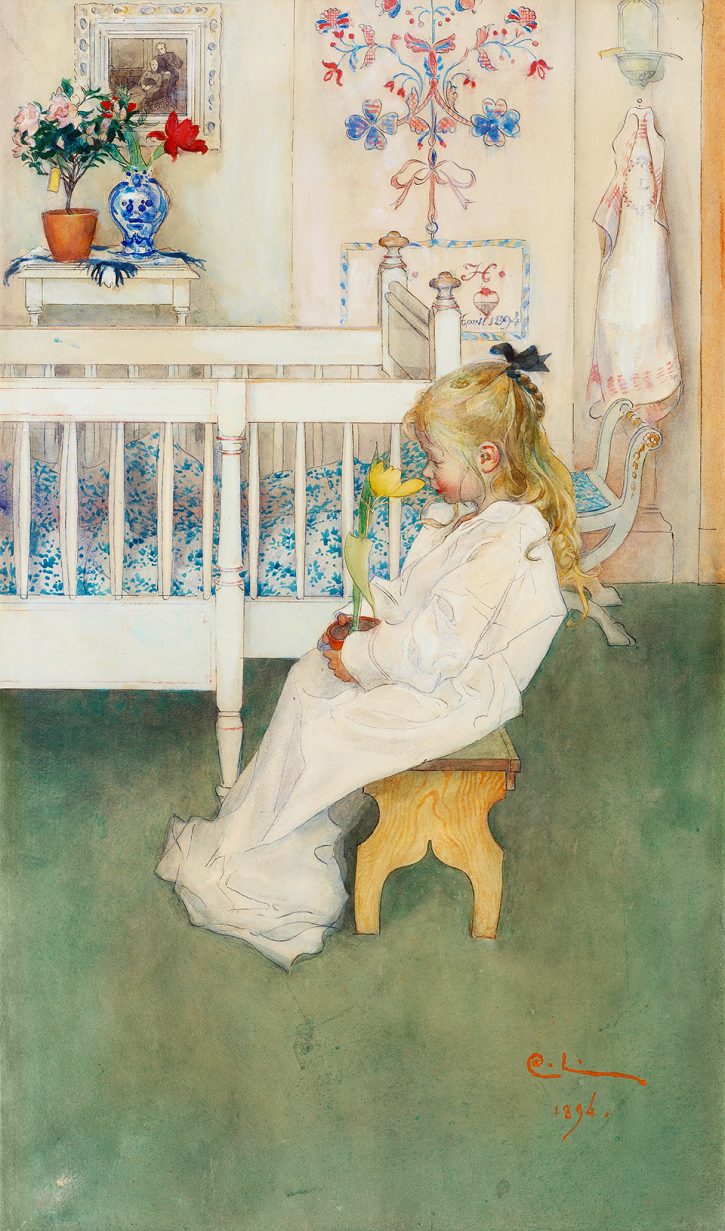
IN THE NIGHTGOWN / LISBETH WITH YELLOW TULIP.
Watercolor, Carl Larsson, 1894.
IN THE NIGHTGOWN / LISBETH WITH YELLOW TULIP. Watercolor, Carl Larsson, 1894.
Lisbeth is born in February 1891 on Glasbruksgatan in Söder in Stockholm. She immediately proves to be a cheerful child and is frequently painted by Carl. Lisbeth trains as a physical therapist and gymnastics director at Arvedson’s Gymnastics Institute in Stockholm. She lives with Brita in Germany during World War I. In 1919, just a few months after Carl’s death, she marries the banker Gustaf Brunkman. They then live in Berlin, Copenhagen and finally in Djursholm. They have three children—Kersti in 1920, Karin in 1923 and Birgit in 1925.

BRITA AND I. Watercolor, Carl Larsson, 1895.
Brita is born in Marstrand in May 1893. She grows up in Stockholm, Gothenburg and during summers in Sundborn. In 1910 she travels to Germany to improve her German and meets Gustav Friederich who later becomes her husband. Brita works during the war as a physical therapist in Bremen and Hamburg. Only after the war, in 1920, can she finally marry Gustav. They have the children Ulwa in 1921, Locki in 1923, Daike in 1925 and Nils in 1930. Gustav dies in 1933 and Brita then moves home to Falun where she resumes work as a physical therapist.

PHOTO: Carl Larsson House. Karin at St. Mark’s Square. Venice, 1894.
PHOTO: Carl Larsson House.
Karin at St. Mark’s Square. Venice, 1894.
In a photograph from Venice in 1894, Karin is seen standing in the wind among the pigeons at St. Mark’s Square. One can see that she is pregnant and it is little Mats who is on the way. Mats is born in Stockholm in November 1894 but dies already in January 1895, only two months old. The grief is great. In a letter to Hilda, Karin writes: “Our little boy fell asleep so gently this morning. He is already wrapped, white and cold out there in the studio. We are grateful that he did not have to suffer any longer.”

KARIN AND KERSTI. Watercolor, Carl Larsson, 1898.
At the end of March 1896, Kersti is born, also frail and weak. But Kersti fortunately survives even though she has problems with her lungs in her youth and spends long periods with the Zorns in Mora to get peace and quiet. When she is strong again, it is her wish to become a gardener. In 1917 she attends Rudolf Abelin’s new gardening school at Adelsnäs and does practical training at Vrams Gunnarstorp. In 1918 she meets the lieutenant Axel Frieberg. They marry in 1921 and move into Spadarvet. They have the children Ulla-Brita in 1922, Anders in 1924, Marit in 1925, Ulf in 1932 and Karin in 1939.

ESBJÖRN. Watercolor, Carl Larsson, 1900.
Esbjörn, who is born in Stockholm on May 5, 1900, becomes their eighth and last child. Already the following year they settle permanently in Sundborn and there Esbjörn grows up. He and Karin spend much time together. Their coffee moments are often described in the letters. Esbjörn trains as an agronomist at Alnarp and buys a farm outside Strängnäs. He marries Greta in 1929, a year after Karin’s death. They have their son Lars in 1930. During the 1930s depression and difficult economic situation, it is hard to manage the farm and Esbjörn is forced to sell it, after which they move to Lilla Hyttnäs. But there the family’s difficulties continue and Esbjörn takes his life in 1937.