




THE EIFFEL TOWER UNDER CONSTRUCTION. Oil, Carl Larsson, 1888.
In his paintings, Carl Larsson captures a sense of harmony and warmth, where every brushstroke tells a story of his life, family and home. His work offers us a glimpse into a world where simplicity is beautiful and every moment is worth preserving—where family life, nature and homeliness are at the centre. His art is not only a depiction of Swedish life, but a reminder to find beauty in the small moments—a cup of coffee, a playful snowstorm, a breakfast table filled with family.
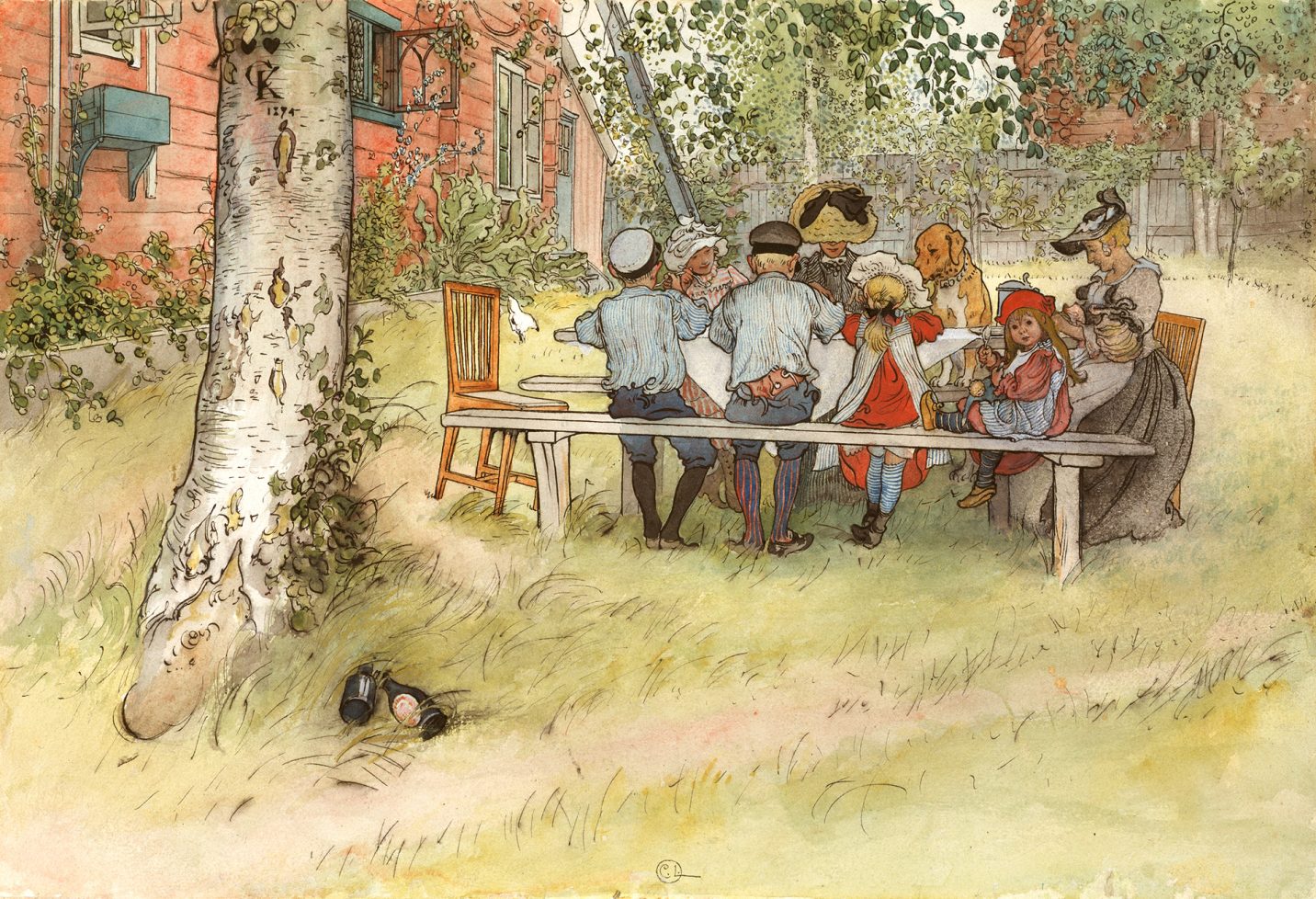
BREAKFAST UNDER THE BIRCH. Watercolour, Carl Larsson, 1896.
The Larsson family is gathered at the wooden table under the birch in the garden. Carl has just left his place at the end of the table, and his chair stands empty. The children wear clothes designed by Karin, and on the birch trunk there is a carved heart with the initials CK 1874. A loving portrayal of everyday life that became one of Carl Larsson’s most beloved works.

TRAIN COLLISION, LAGERLUNDA. Illustration, Carl Larsson, 1875.
In his early years, Carl supports himself through illustration commissions for magazines and newspapers. His ability to capture drama and detail in his drawings shows the technical foundation that would later characterise his artistry. Here, two night trains are depicted after a head-on collision in Lagerlunda—one travelling from Stockholm towards Malmö and one in the opposite direction.
Carl Larsson was born in 1853 in Gamla stan, Stockholm, and early on shows artistic talent. As a young student at the Principles School and later at the Royal Academy of Fine Arts (1871–1876), he develops his precision in drawing and his eye for detail. This would shape his entire artistic career. During these years, he also begins illustrating newspapers and books. His first commissions are for Kasper and Ny illustrerad tidning, where he depicts, among other things, dramatic news events with great precision and a strong sense of storytelling.
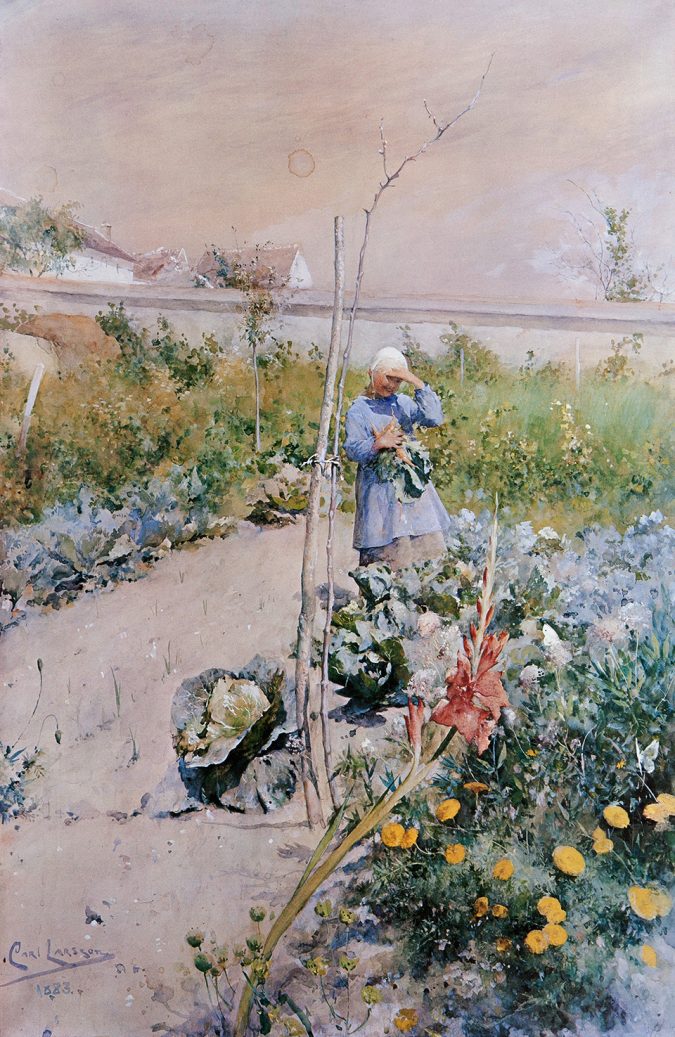
IN THE KITCHEN GARDEN. Watercolour, Carl Larsson, 1883.

THE WINE. Watercolour, Carl Larsson, 1884.

THE WINE. Watercolour, Carl Larsson, 1884.
Carl Larsson travels abroad for the first time in 1877–78 and lives periodically in Paris. There he discovers new currents in European art and paints smaller oil paintings focusing on light and composition. In the summer of 1882, he moves to the Scandinavian artists’ colony in Grez-sur-Loing. There he finds both his life partner Karin Bergöö and his artistic expression.
In Grez, his watercolour painting flourishes. Works such as “In the Kitchen Garden” (1883), “The Old Man and the New Planting” (1883) and “The Wine” (1884) capture rural life in France with light, warmth and presence. Here, Carl develops a style characterised by a light touch, bright colours and everyday subjects. It becomes an important foundation for his later work.
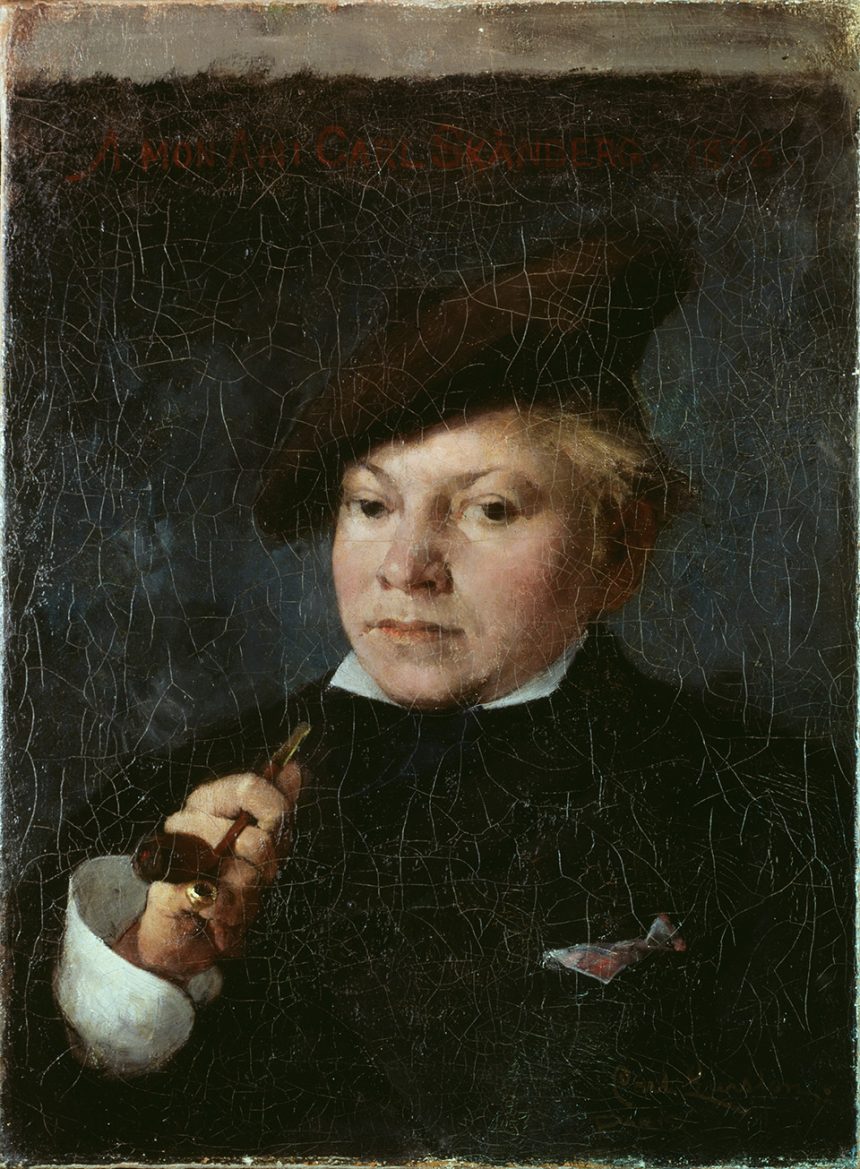
ELEGANT AS A RUFF PIN, CARL SKÅNBERG. Oil, Carl Larsson, 1878.
ELEGANT AS A RUFF PIN, CARL SKÅNBERG.
Oil, Carl Larsson 1878.
Portrait of the plein-air painter Carl Skånberg, painted in oil by Carl Larsson during a period of intense socialising among the Swedes in Paris. They were then facing two important occasions to present themselves—the great World’s Fair and the customary Salon. The portrait is accepted for the Salon and wins approval among Larsson’s fellow artists—unlike several of his other works from this time, which are seen as overly academic and therefore considered out of date.
Alongside his watercolours, Carl Larsson paints portraits of friends and prominent cultural figures—including Selma Lagerlöf, Anders Zorn, Prince Eugen and August Strindberg. The portraits show his ability to capture both character and soul. They become an important source of income that gives him the freedom to continue developing his watercolour painting.
At the same time, this period is marked by strong tensions: Larsson and Strindberg go from close friendship to bitter conflict, while Lagerlöf becomes one of Larsson’s most loyal allies. Together, these works reflect the personal dramas that shaped Swedish cultural life at the turn of the century.

AUGUST STRINDBERG. Watercolour, Carl Larsson, 1899.
The portrait of Strindberg is created while Larsson and the author are still close friends. Strindberg regards his portrait as a masterpiece. Shortly afterwards, their relationship breaks off abruptly, after Strindberg attacks Karin in the book “En ny blå bok” and calls Larsson “the personification of falseness”.

SELMA LAGERLÖF. Watercolour, Carl Larsson, 1902.
The portrait is published on the cover of Idun in 1914, when Lagerlöf, as the first woman, is elected to the Swedish Academy. During the conflict with Strindberg, Lagerlöf becomes a clear source of support for Larsson. The portrait, executed in black chalk with restrained colouring, expresses their mutual respect.
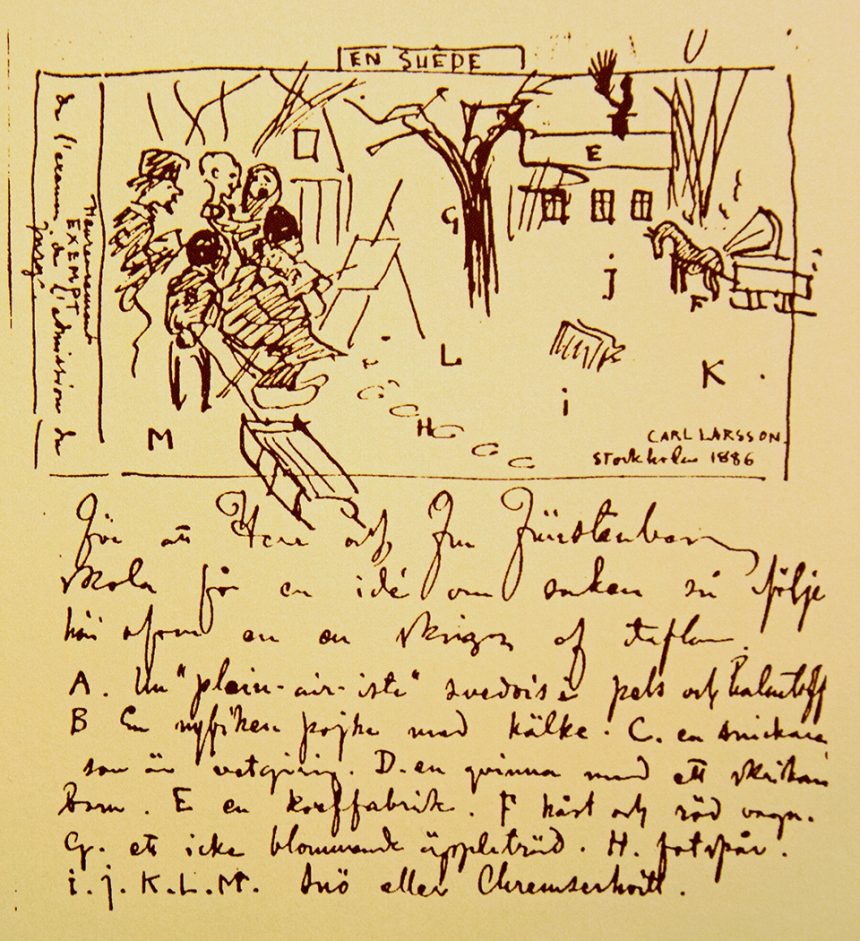
CONCEPT SKETCH, THE PLEIN-AIR PAINTER. Carl Larsson, 1886.
In an illustrated letter to the art collector Pontus Fürstenberg, Carl Larsson combines text and image to convey the painting “The Plein-Air Painter”. “So that Mr and Mrs Fürstenberg may get an idea of the matter, above follows a sketch of the painting. The painting is marked with letters and short explanations, such as B: A curious boy with a sledge, C: a carpenter who is inquisitive.”
The art collector, patron and friend Pontus Fürstenberg in Gothenburg plays a decisive role in Carl Larsson’s artistic life. Fürstenberg’s support gives Carl both financial stability and artistic freedom—conditions that make his best-known works possible. Many of the watercolours that define the Sundborn style take shape thanks to Fürstenberg’s encouragement and contacts in the wider world.

THE PLEIN-AIR PAINTER. Oil, Carl Larsson, 1886.
In the autumn of 1885, Carl Larsson paints his large winter scene The Plein-Air Painter on Södermalm in Stockholm. Carl experiments with plein-air painting, light, atmosphere and everyday moments—something that would later become characteristic of his Sundborn watercolours. The painting is shown at the Paris Salon in 1886 and is noted for its realistic and Nordic expression.

MOTIF FROM MARSTRAND. Watercolour, Carl Larsson, 1893.
In the summer of 1893, the family spends time in Marstrand. There are many motifs here that appeal to Carl Larsson—the Bohuslän archipelago setting and family life in the summer light. It is a creative period in which the everyday scenes with the children consolidate his artistic focus on depicting family life, something that would later become his hallmark.
After returning to Sweden, Carl lives alternately in Stockholm, Gothenburg and Varberg before he and Karin settle permanently at Lilla Hyttnäs in Sundborn in 1901. The home and life there become the core of his art. He paints bright, everyday motifs featuring family, dogs, servants and the home itself. The works in the Sundborn watercolours, such as “The Family” (1895) and “A Home” (1899), show a genuine warmth, humour and tenderness. This makes his art beloved both in Sweden and abroad.
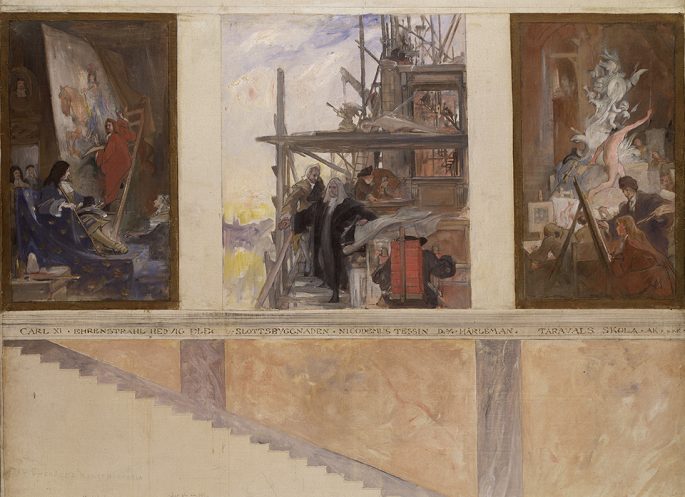

SKETCHES FOR THE FRESCOES. Oil, Carl Larsson, 1896.
The oil paintings show Carl Larsson’s early proposals for the frescoes in the staircase hall of the Nationalmuseum. After the mural painting committee announces and revises the competition, and a long debate follows, Larsson develops his ideas further. In the second proposal, to the right above for the north wall, the motifs are reworked: the scene with Lovisa Ulrika and Carl Gustaf Tessin is changed, and Sergel is now working on Cupid and Psyche instead of the statue of Gustav III. The sketches become an important step towards the proposal that ultimately earns Larsson the commission.
Carl Larsson is also a master of monumental painting. His murals and frescoes adorn public buildings such as Norra Latin in Stockholm (1901), the Latin School in Gothenburg (1903) and the Royal Dramatic Theatre in Stockholm (1906–07). Early in his career, he creates the impressive triptych “Renaissance, Rococo, Contemporary Art” for the Fürstenberg Palace in Gothenburg (1888–89), a work that shows his ability to combine allegory with a strong linear rhythm.
Back in Sweden, Carl takes on another kind of monumental painting to give the entire population access to art and history. At the Nationalmuseum in Stockholm, you can see the six frescoes that together tell the story of Swedish art from Ehrenstrahl to Sergel. It is a cohesive theme with a strong linear rhythm and clearly defined contours. There is also “Gustav Vasa’s Entry into Stockholm” (1908) and the dramatic “Midvinterblot” (1915). They show his powerful style, allegorical themes and fascination with history, mythology and Swedish traditions.


SINGOALLA. Illustration, Carl Larsson, 1894.
Carl Larsson creates dramatic illustrations for Viktor Rydberg’s novel “Singoalla” (1894). The story is set in the Middle Ages and depicts the forbidden love between the knight’s son Erland Månesköld and the enigmatic Singoalla. Larsson’s images capture the novel’s dark romanticism, fateful moods and central themes of guilt, love and reconciliation.


Carl Larsson is a prolific illustrator who works for newspapers such as “Ny Illustrerad Tidning” and illustrates classics such as “Topelius’ The Surgeon’s Stories” (1880–1884) and “Andersen’s Fairy Tales” (1876–1877). He also creates illustrations for Viktor Rydberg’s “Singoalla” (1894). Carl Larsson’s style is characterised by a narrative expression, often humorous and rich in detail. It influences his entire artistic development.
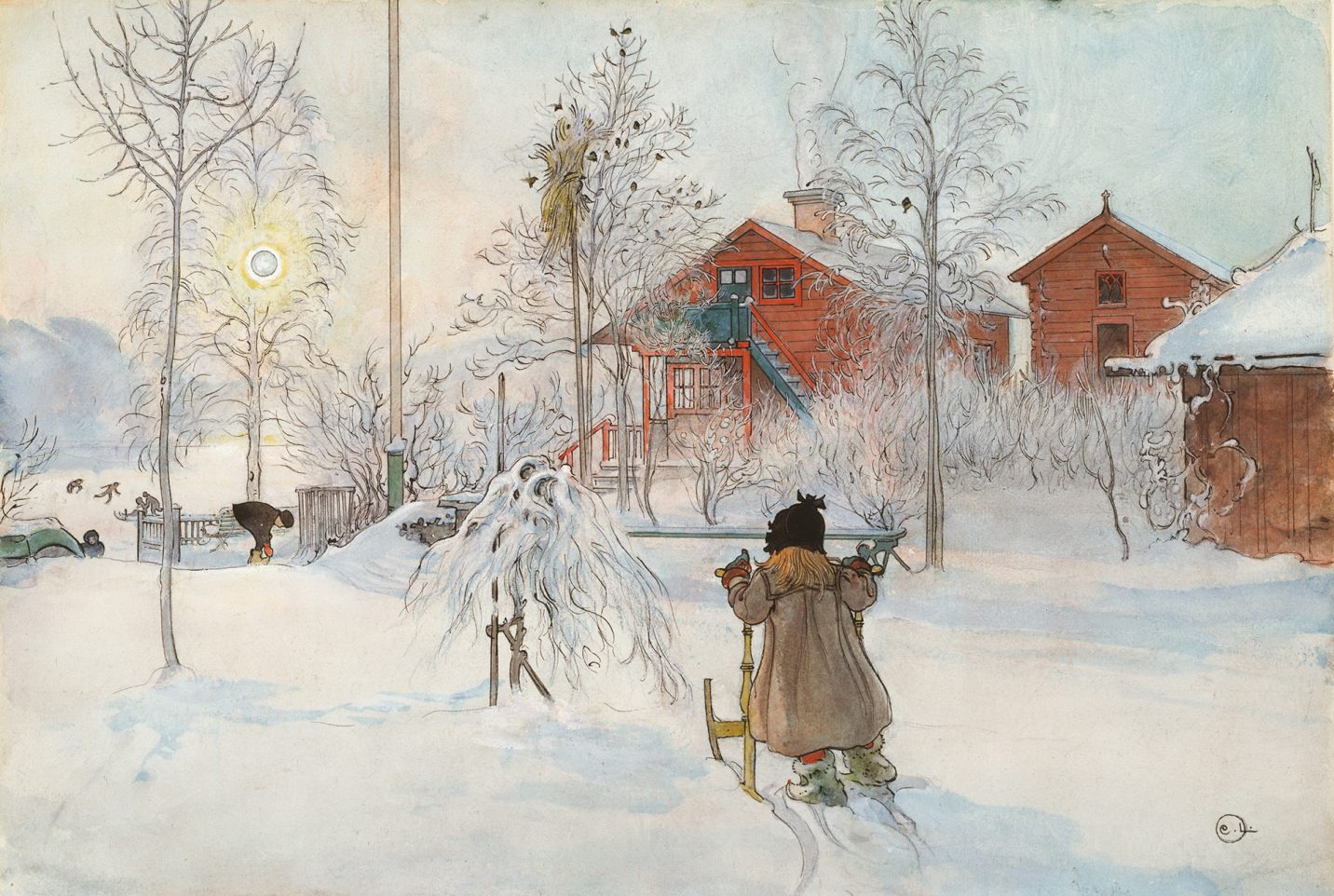
THE YARD AND THE BREWHOUSE. Watercolour, Carl Larsson, 1897.
The painting is one of Carl Larsson’s few winter scenes, where frost-covered trees surround the red wooden houses. The work is included in the book “A Home”, through whose images Carl becomes beloved all over the world. The paintings are made for reproduction with clear lines and only four colours.
What Carl Larsson is most associated with today are his bright watercolours from Sundborn. When the book A Home is published in 1899, it becomes a breakthrough. The twenty-four watercolours from Lilla Hyttnäs, with motifs such as “Breakfast under the Big Birch”, “The Kitchen”, “The Yard and the Brewhouse” and “When the Children Have Gone to Bed”, show not only Carl’s sense of light and everyday life, but also Karin’s creative solutions in the home. Her textiles, floral arrangements and furnishing create a unique environment that gives Carl’s paintings their special charm. The book makes him a household name in Sweden while also presenting a new view of the home as an artistic and social centre.