
THE WORKSHOP. Watercolor, Carl Larsson, 1908.
We glimpse Karin’s arm working at the loom in the workshop, and Carl describes in the book “Towards the Sunny Side” that his former studio is now “…the housewife’s craft cottage, where the loom and spinning wheel are tightened for daily work.” Karin’s textiles are innovative and expressive. Powerful colors and Japanese influences pave the way for abstract textile art. For her, design and execution are one unit. As a textile artist, she blends traditional folk textiles with the flowing lines of Art Nouveau and the craft ideals of the Arts & Crafts movement. She creates clothes that express modernity and freedom for both herself and her children.

PHOTO: Carl Larsson-gården, 1906.
Karin works at the tapestry loom in the workshop at Lilla Hyttnäs. The workshop is Carl’s first studio, which has now become her workspace. Here, she finds room for her creativity and a place for creation. She is dressed in her characteristic dress with a striped apron. It is also Karin who, with refined taste and skilled hands, sews together the costumes Carl Larsson needs for his models. Further into the studio, Carl can be glimpsed looking out the window, while one of the couple’s daughters sits on the bench to the right, dressed in a Sundborn costume.
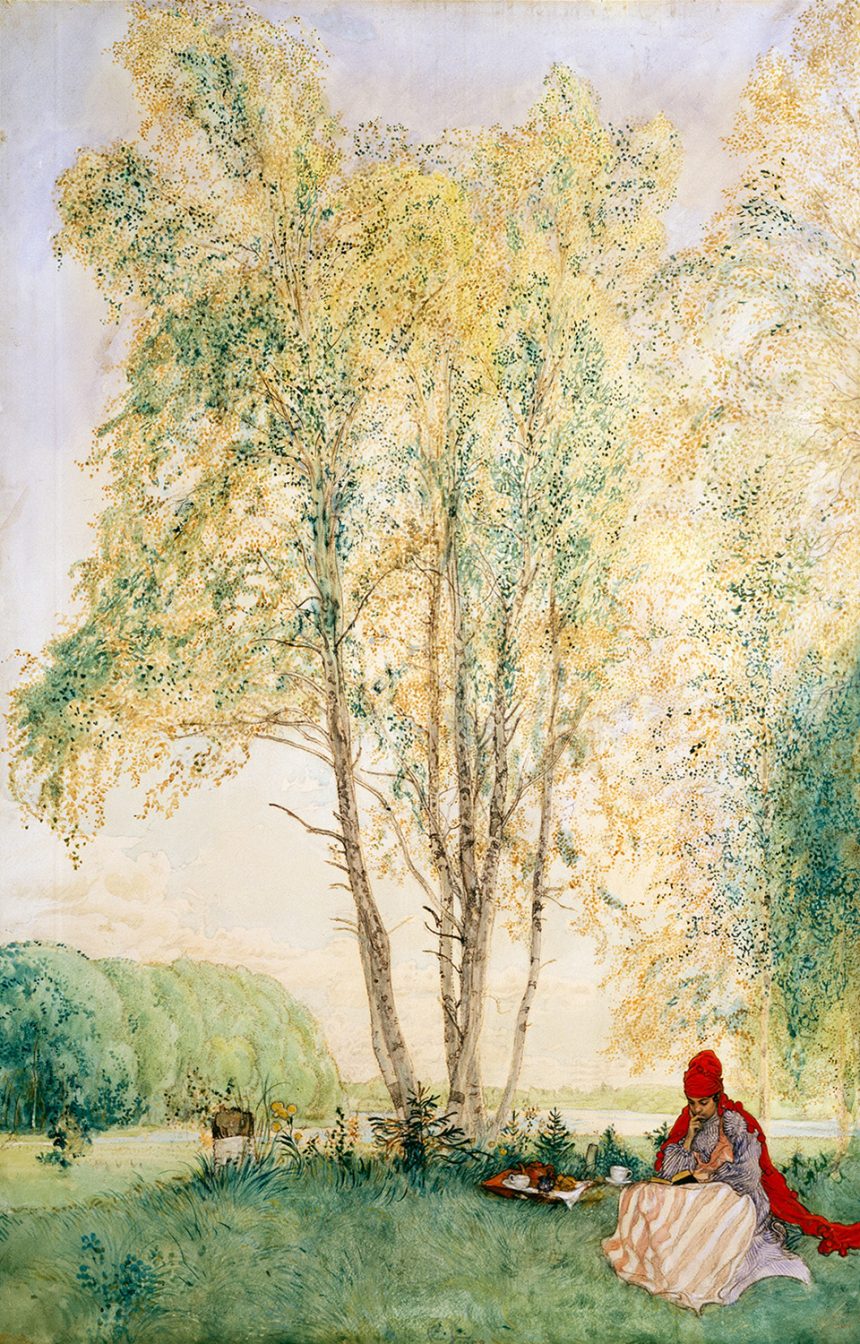
UNDER THE BIRCHES. Watercolor, Carl Larsson, 1902.
Despite the large family, the industrious Karin finds moments of stillness – as here with a book – but she almost always has something in her hands. The striped dress she wears she designed herself, and on her head, she has the red scarf with pom-poms that she often uses.
For Karin, clothes are an expression of her artistic identity. She develops her own style, influenced by contemporary fashion and movements. Without restrictive corsets, Karin creates clothes that possess a natural elegance while being comfortable and made for movement and everyday use. The striped dress depicted in the watercolor “Under the Birches” is still worn today by the guides at Carl Larsson-gården.

BRITA, A CAT AND A SANDWICH. Watercolor, Carl Larsson, 1898.
BRITA, A CAT AND A SANDWICH.
Watercolor, Carl Larsson, 1898.
A glimpse of everyday life where Brita eats a sandwich with the cat at her feet. She wears clothes that Karin designed and sewed – practical garments made for children’s movements, comfortable to wear, and beautiful to look at.
The family’s eight children constantly need clothes during their upbringing, for different occasions and seasons. Karin sews simple, beautiful, and functional clothes that do not restrict the children’s play. She largely follows the fashion of the time and uses durable materials such as linen, cotton, and wool. She embroiders details and incorporates handmade elements where patterns are inspired by nature and reflect her fondness for harmony and simplicity.

KARIN IN A LARGE HAT. Oil sketch, Carl Larsson, 1905.
Karin Larsson’s creative work is characterized by curiosity, innovation, and an openness to trends and influences that she adopts and makes her own. It is said that when one of the weavers at home accidentally weaves incorrectly, Karin says: “Keep going… the hand should be visible.”
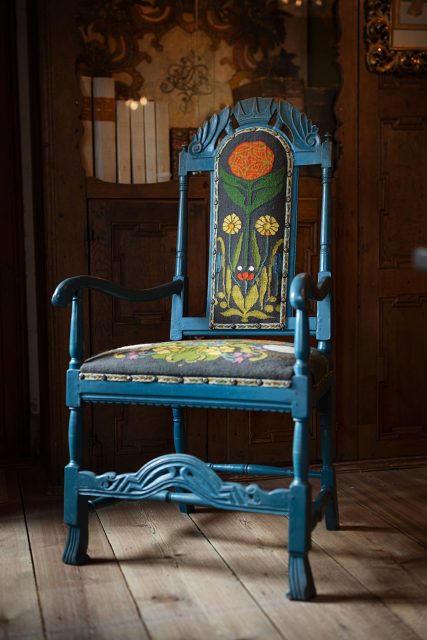
During the 19th and early 20th centuries, hats were a central part of women’s attire. Karin often wore hats, and her hats frequently had a generous shape with decorative details reminiscent of her textile and interior designs. There are many examples in art, such as “Breakfast in the Green” and “Lisbeth Bridesmaid.” With the white sun hat depicted in “Karin and Brita in the Garden,” Karin was far ahead of her time. The hat is designed to protect from the sun, and its most important feature is the far-protruding brim, which is stiff to shield the face from the sun. She achieves this by sewing layers of fabric held together with decorative stitching.
The sun hat is well preserved at Lilla Hyttnäs, but the great-grandchildren’s children are not allowed to use it when they dress up. A tradition that has lived on in the family since Carl and Karin’s time.
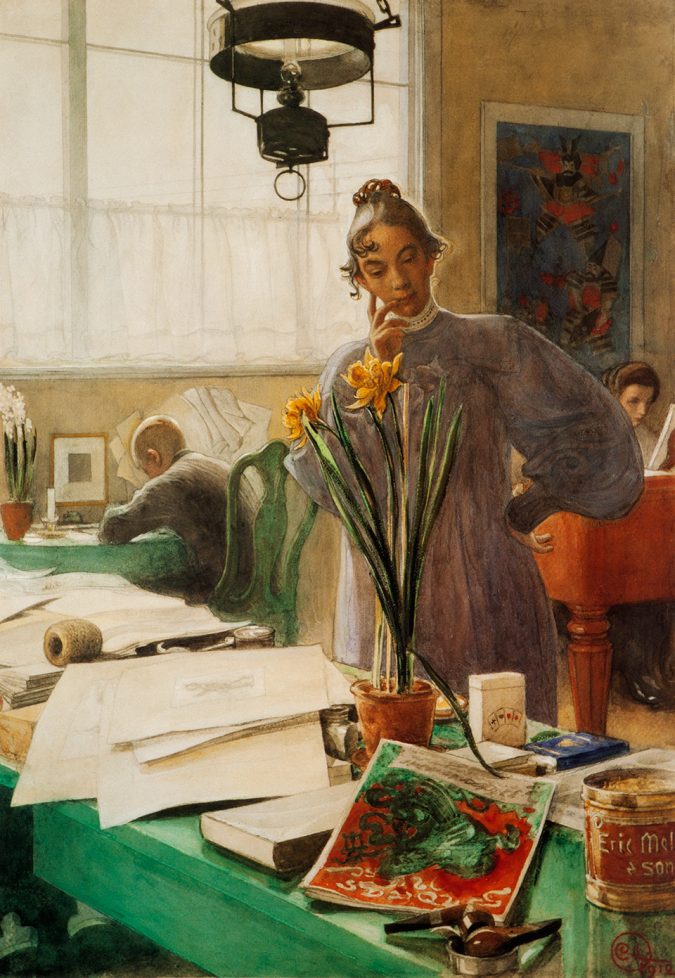
MY WIFE. Watercolor, Carl Larsson, 1912.

HIDE-AND-SEEK. Watercolor, Carl Larsson, 1898.
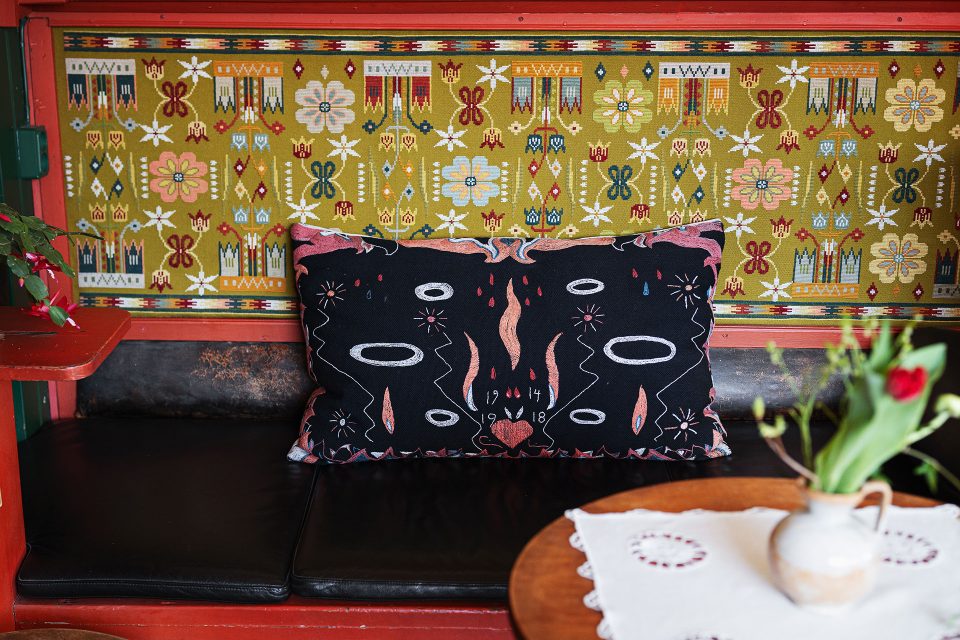
Karin is a visionary, technically adventurous, and skilled. She does not shy away from experimenting and renewing traditional folk techniques, while also incorporating new forms of expression. An example of her bold vision is the tapestry “The Four Elements,” which she created in 1903 for the sofa in the dining room at Lilla Hyttnäs. Karin’s works, filled with strong colors and expressive motifs on cushions, curtains, and wall hangings, contribute to a new home ideal characterized by light, harmony, and creativity.
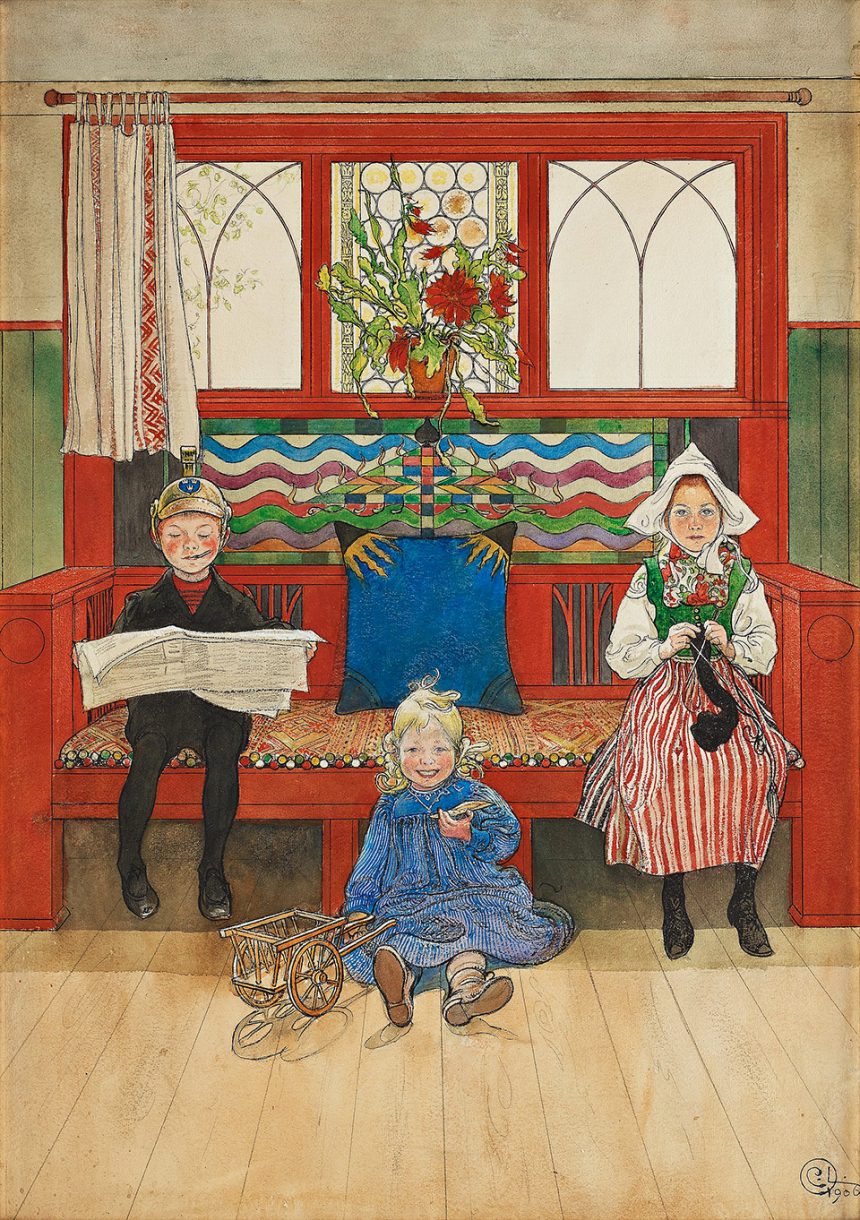
DAD, MOM, CHILDREN. Watercolor, Carl Larsson, 1906.
Behind the three children, the tapestry “The Four Elements” can be seen, composed by Karin in 1903 to adorn the dining room’s new sofa. The pattern is a prominent example of her bold and innovative textile art. Karin’s textiles are highly original, often featuring abstract patterns, powerful compositions in vibrant colors, and stylized plant motifs. She explores folk traditions with technical experimental zeal and develops her own expressions.
THE FOUR ELEMENTS. Weaving, Karin Larsson, 1903
Innovative and daring for its time are the strong color fields and the rhythmic pattern. On the reverse, the colors are preserved as Karin saw them. In the sun motif at the top left, she weaves in the year 1903, and above the lower checkered border, she adds a human figure, a light basket, and two cross symbols that deepen the work’s expression.
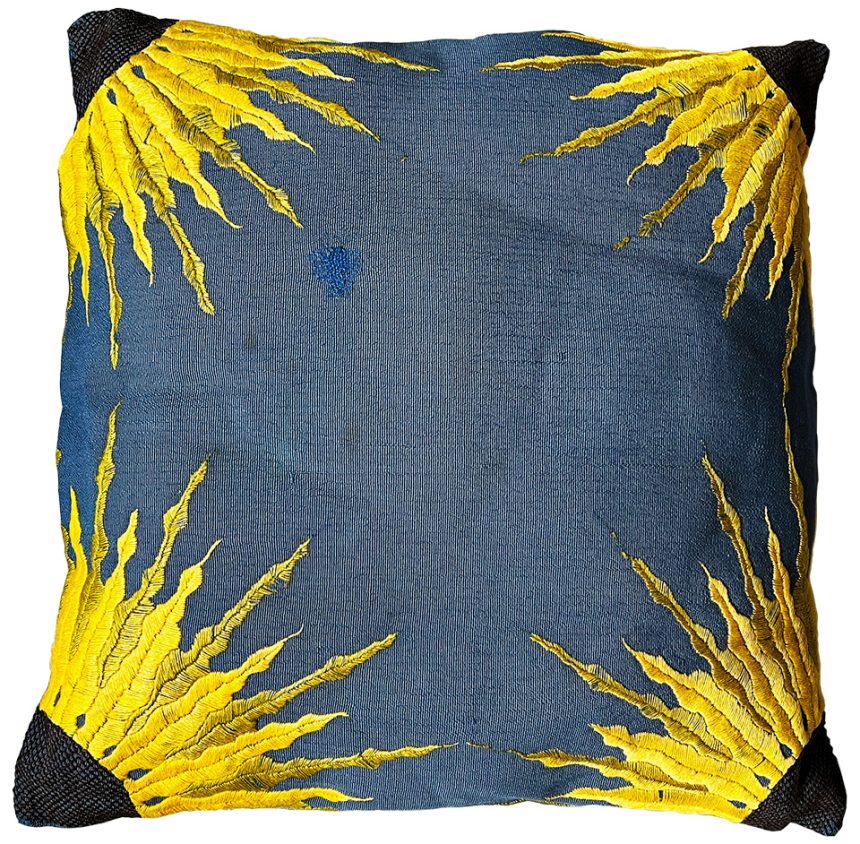
PHOTO: Carl Larsson-gården.
Karin’s original sunflower cushion is well-used and appears in several of Carl’s watercolors. The cushion has its place on the dining room sofa. In each corner, Karin embroidered a stylized sunflower, one of the most cherished motifs in Swedish Art Nouveau. It is sewn in satin stitch, stem stitch, and cross-stitch on wool fabric. The colors are well preserved and show the nuances Karin intended. Today, a copy lies in the same spot on the sofa, and for those who wish to sew their own cushion, a needlework kit can be purchased at the farm.