THE FLOWER WINDOW. Watercolor, Carl Larsson, 1894.
In his paintings, Carl captures a sense of harmony and warmth, where each brushstroke tells a story about his life, family, and home. His works offer us a glimpse into a world where simplicity is beautiful and where every moment is worth preserving. His art is not merely a depiction of Swedish life, but a reminder to find beauty in the small moments—a cup of coffee, a playful snowstorm, a breakfast table filled with family.


PHOTO: Carl Larsson House.
Full of life in the lush and verdant garden at Lilla Hyttnäs—a snapshot of family life in Sundborn.
Carl and Karin’s home in Sundborn grows from two simple rooms to a house with fourteen rooms and two studios. Each room bears traces of their hands and lives. Here, an environment is created that is both the family’s sanctuary and a living work of art. The rooms are shaped around the children as much as around their parents. Perhaps that is why it never becomes a museum—it remains a living home where everyday life continues, generation after generation. The family uses the house in the same way today. The tradition lives on.
KARIN READING. Watercolor, Carl Larsson, 1904.
At the dining table, Karin sits reading, illuminated by the warm glow of the lamp. When the paintings are published in various books, the new domestic ideals from the artist’s home in Sundborn spread to a broad international audience.
Each room at Lilla Hyttnäs has its own style. The rooms are boldly colored and alternate between light and shadow with strong contrasts—the dining room with its colors in green and red-orange meets the bright parlor in Gustavian pastels.
Karin designs furniture and creates textiles with confident sensibility. Her textiles—embroideries, tapestries, and fabrics—deepen the atmosphere in each room. Simple furniture and clear colors contrast with the era’s heavy, dark bourgeois ideals. Flowers from the garden in imaginative arrangements fill the home with life and hold a central place in Carl’s works. Carl contributes with floral garlands, mottos, and glass paintings.
Carl and Karin’s home stands open to all—friends, villagers, craftsmen, writers, princes, and other guests are welcomed equally warmly into the home. Karin serves good food prepared with ingredients from their own garden, among other things, and introduces new flavors she learned in France.
Everyone gathers at the same table. During summer, meals are eaten outside in the garden, while winter invites cozy gatherings in the dining room. For larger celebrations and feasts, the family sets the table in the large studio, which is transformed into a banquet hall.
PHOTO: Carl Larsson House.
It is not uncommon for Carl and Karin to have many guests. Daughter Suzanne describes: “Good food, mother could conjure up. She had learned that in France. That skill was often put to the test when father, following his kind heart’s impulse, quite unexpectedly invited many visitors to dinner.”
SEWING GIRLS. Watercolor, Carl Larsson, 1913.
BRITA IN THE PARLOR. Watercolor, Carl Larsson, 1910.
IN THE MINER’S COTTAGE. Watercolor, Carl Larsson, 1914.
THE KITCHEN. Watercolor, Carl Larsson, 1898.
At Lilla Hyttnäs, each room has its specific function. Karin’s workshop is dedicated to textile creation, Carl’s studio to monumental paintings. The old room gives guests their own experience, the reading room offers space for edification, the parlor invites conversation over a cup of tea, the dining room gathers the family, and the Miner’s Cottage provides peace and seclusion. Together, the rooms form a thoughtfully designed home where creativity, community, and everyday life unite.
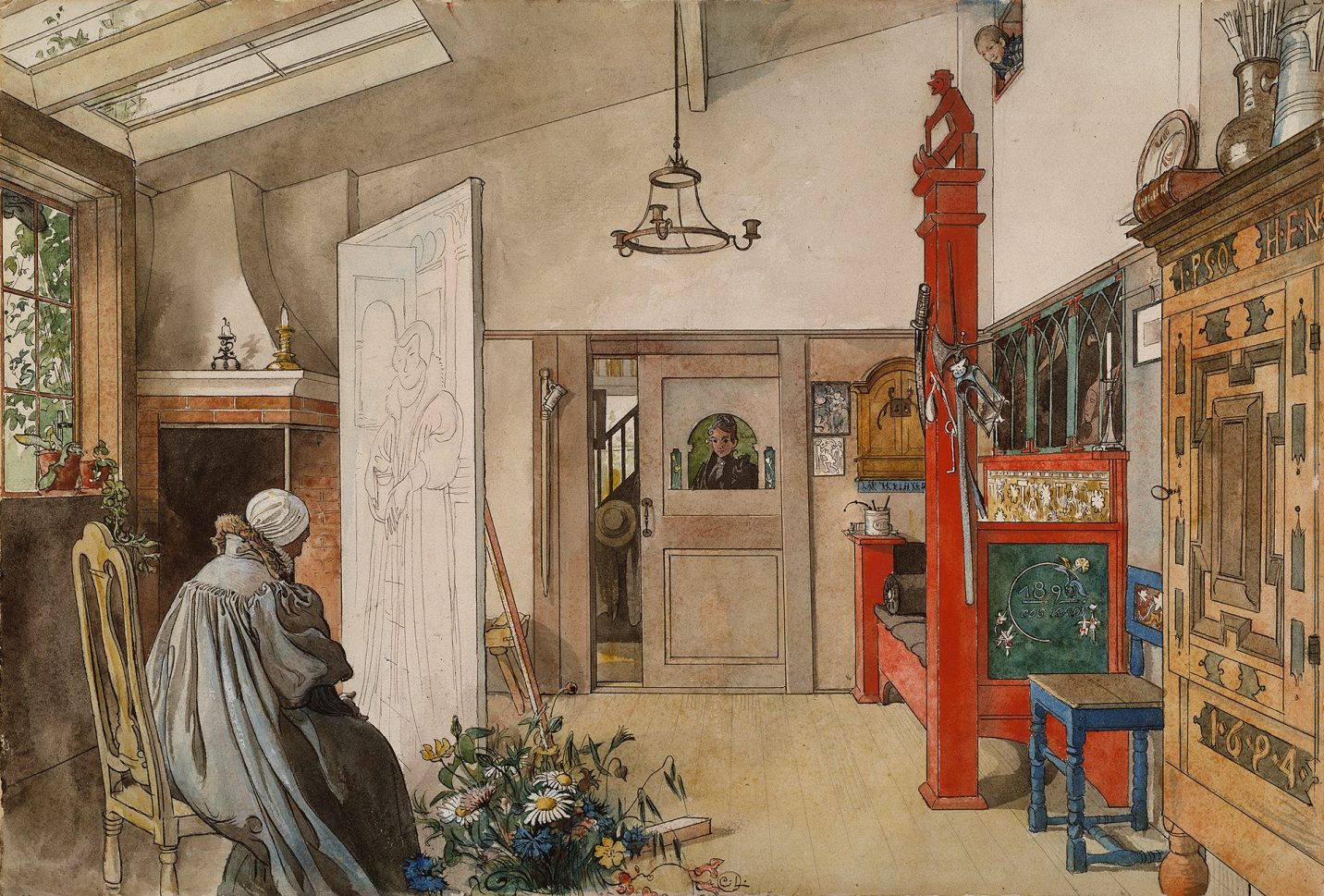
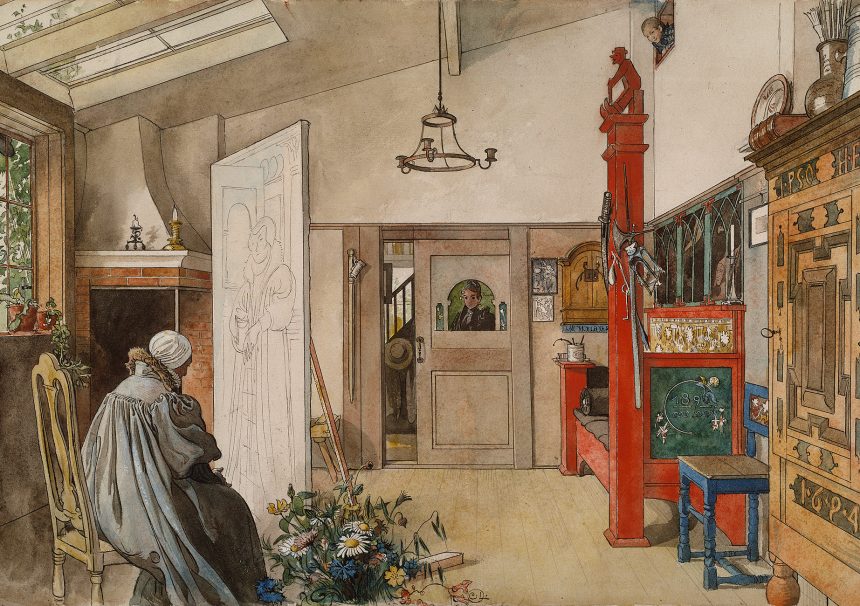
The workshop is initially Carl’s studio but over time becomes Karin’s workplace. The many windows let light in over the loom and sewing machine. Here her textiles take shape: bold patterns, daring colors, an entirely new design language that breaks with the norms of the time.
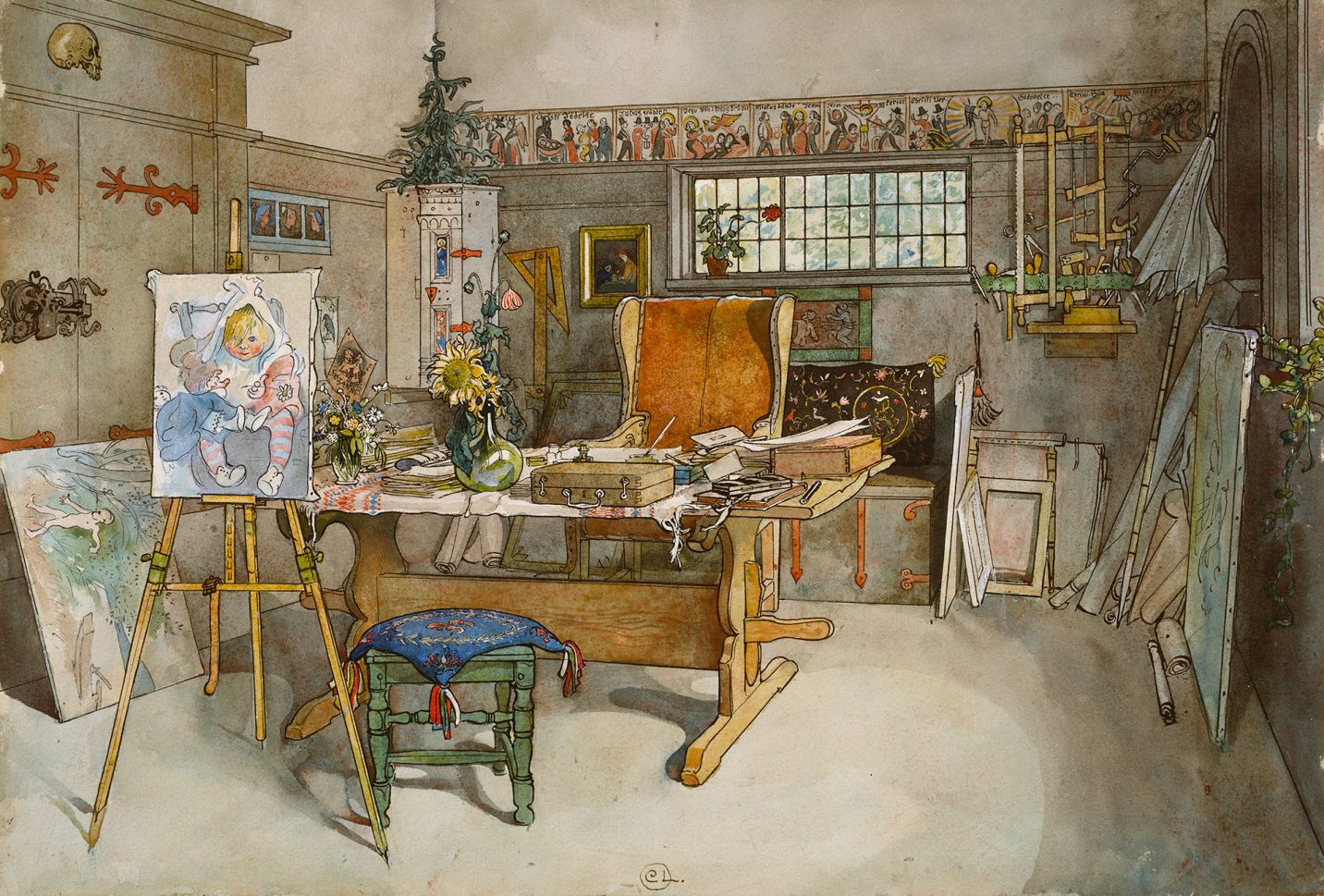
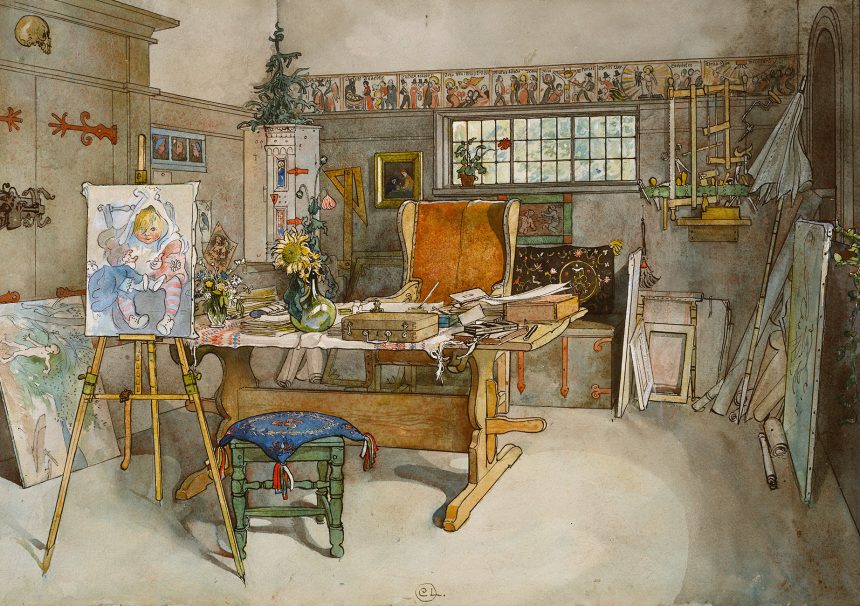
In the large studio—one of Scandinavia’s largest when it is built—Carl works on his monumental pieces. The ceiling height provides freedom, the light falls cleanly through the tall windows. On the western wall hangs an oak panel from the 17th century, on the northern wall the cartoon for the fresco The Chorus of Schoolchildren dominates. Here is the heart of his artistic practice.


THE STUDIO, ONE HALF. / THE STUDIO, THE OTHER HALF. Carl Larsson, watercolor, 1894.
THE STUDIO, ONE HALF. / THE STUDIO, THE OTHER HALF.
Carl Larsson, watercolor, 1894.
In “One Half” and “The Other Half,” Carl Larsson shows two perspectives on the same reality: his home and studio. The works demonstrate how the boundary between the artist’s workplace and the family’s home is blurred. The home is not only a private sphere but also a workshop for creation.
PHOTO: Carl Larsson House.
The meal is an important moment for the Larsson family. Often the entire family, children and adults, gathers at the same table, and not infrequently guests are spontaneously invited to dinner. Karin is a skilled cook—an art she learned in France. Everyone is welcome, both friends and sometimes unknown tourists. To this day, the family eats dinner in the dining room at Lilla Hyttnäs.
The dining room is one of Sweden’s most painted rooms. At Karin’s textile tablecloths, guests gather around the dining table. The color choices provoke: red, green, yellow—no muted tones, no compromises.
During holidays, the large studio becomes a banquet hall. Long tables are set, candles are lit, and the room that usually echoes with Carl’s brushstrokes fills with laughter, speeches, and song. At the Larssons’ home, dinner guests could be artist colleagues, princes, and Nobel Prize winners as well as friends from the village and craftsmen.
In the parlor—sunlit in blue and white—geraniums bloom in the windows. The view glitters toward the stream. Here, simpler meals are eaten beneath painted ceiling details by Carl, surrounded by Karin’s restrained elegance.
CHRISTMAS EVE. Watercolor, Carl Larsson, 1904–1905.
The house is full and the three maids Anna, Tilda, and Martina serve while Karin says “Please help yourself!” and Suzanne and Lisbeth pass around the bread. Carl describes the scene as an “agricultural exhibition” of food—home-churned butter, smoked mutton, meatballs, and the sacred Christmas ham.
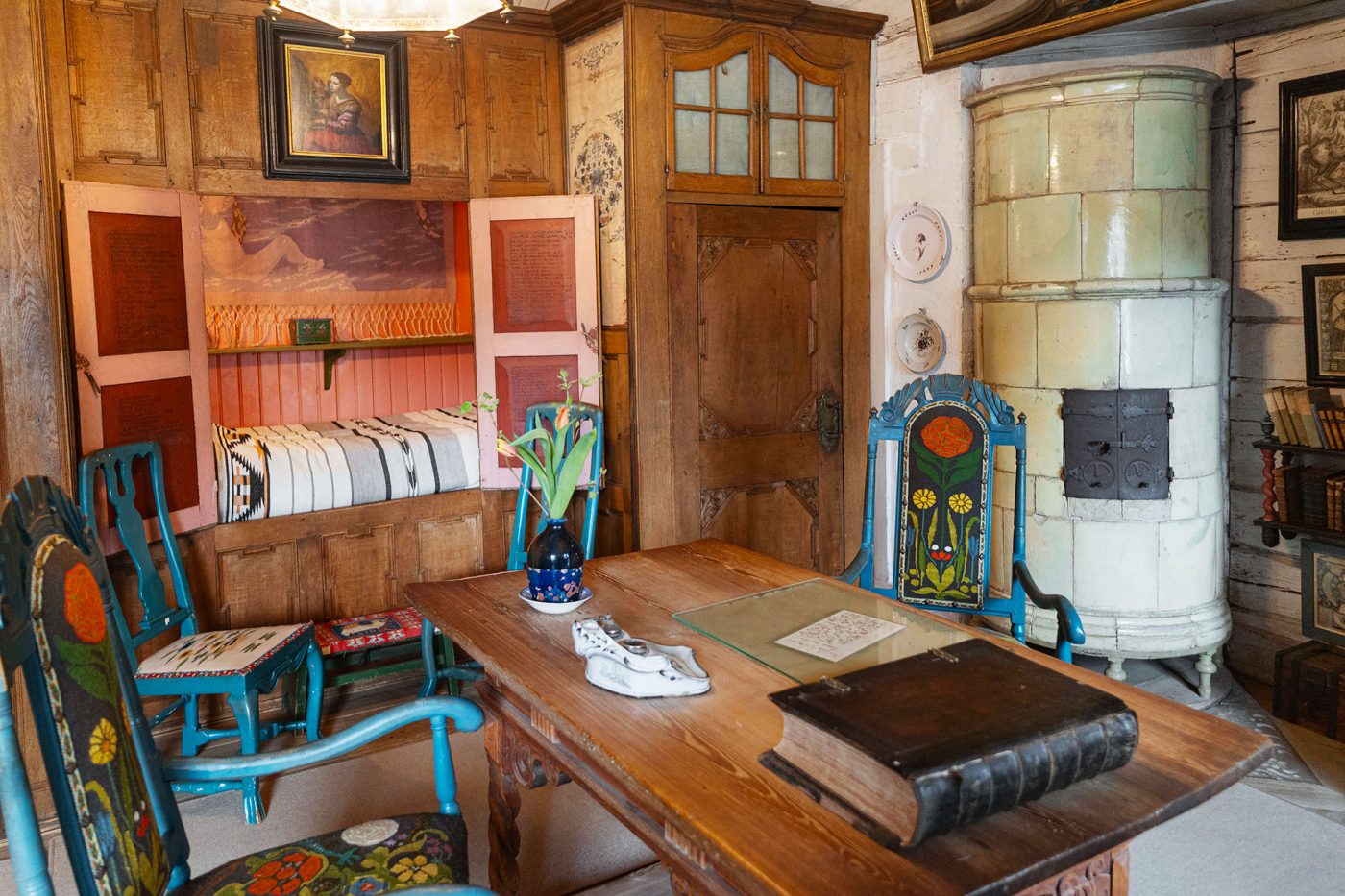
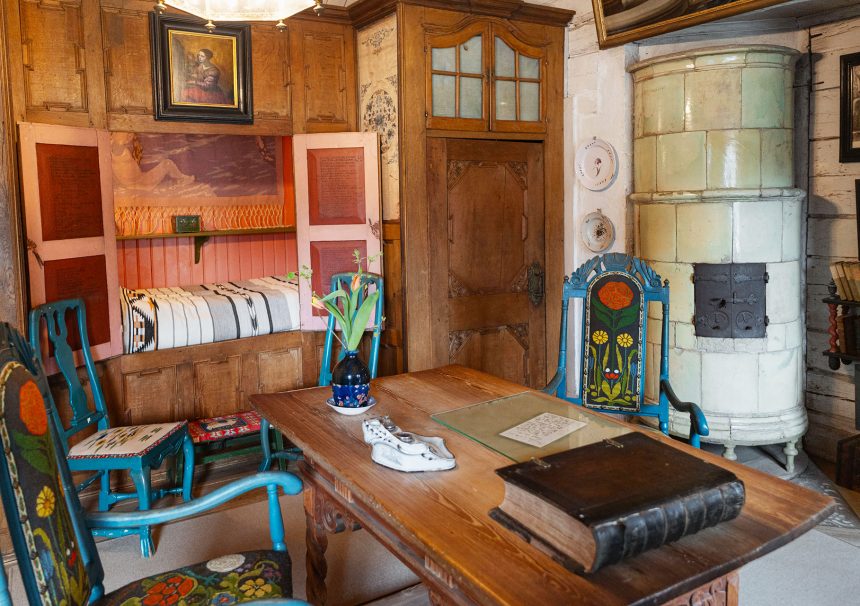
The old room becomes a guest room, filled with objects Carl collects over the years. On the doors, guests write their names—among others, we find Prince Eugen, Selma Lagerlöf, and Anders Zorn there. Here are the blue chairs with cushions woven by Karin. The pattern is beautiful, and with a twinkle in her eye, Karin has hidden seven animals in the pattern. Look closely—the hare and the frog are easy to spot.
But the home is not opened only to celebrities. Neighbors, craftsmen, and friends move through the rooms. The village carpenter Arnbom comes with new chairs, the children’s playmates with games and laughter. The house lives from the community that arises when art and everyday life meet without boundaries.
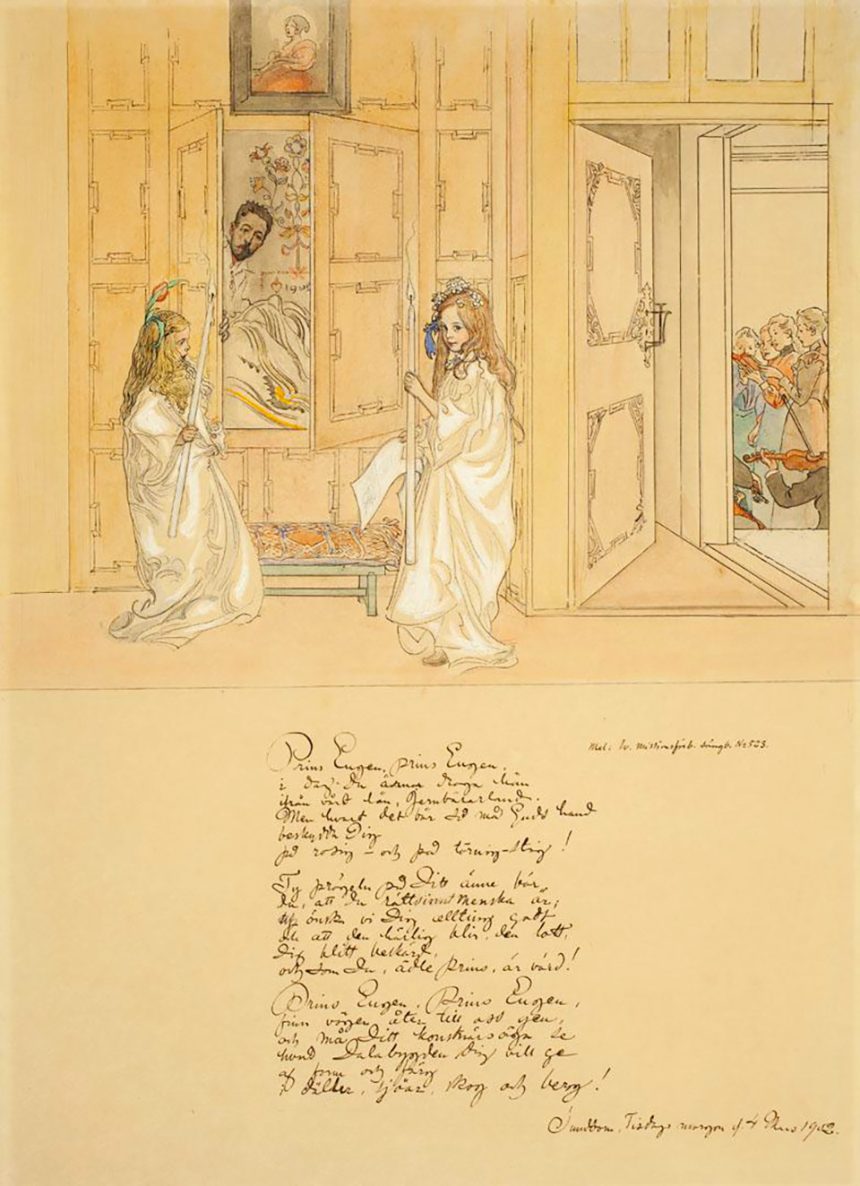
MORNING SERENADE FOR PRINCE EUGEN AT LILLA HYTTNÄS. Watercolor, Carl Larsson, 1902.
Daughters Suzanne and Lisbeth perform a humorous poem for Prince Eugen. The poem congratulates the prince and is a charming tribute from the Larsson family to the art-loving prince. The guest room at Lilla Hyttnäs has over the years received many famous guests, all of whom have had their names on the doors to the bed.
KERSTI IN THE READING ROOM. Watercolor, Carl Larsson, 1909.
In the family’s reading room, quiet concentration prevails. Kersti sits absorbed in her book, surrounded by shelves filled with volumes—knowledge, stories, and inspiration. The books have a natural place in the home.
The reading room is small but feels large. All walls are covered with books and art. Carl calls it a sanctuary—a place for contemplation and reflection. In his bedroom, the bookshelves continue along the walls high up under the ceiling, as if literature needs more space than a single room can provide.
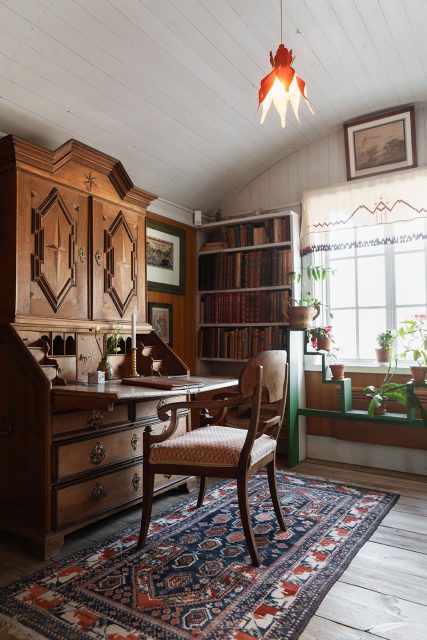
On the upper floor, Karin has her writing corner. Here stands her famous flower staircase—a construction where plants are grown in steps toward the window. Here she writes letters to her mother and later to her children.
Carl’s bed stands in the middle of the room, surrounded by light draperies with Karin’s embroideries. Adjacent lies Karin’s and the children’s bedroom, connected to Carl’s through an opening covered by the drapery “The Rose of Love.” Under her bed is clever storage with drawers, while the children’s small beds are painted in bold green.
Above the studio in the attic, the Dovecote is furnished to provide more sleeping spaces when the family grows and guests become numerous. It is still used when the family gathers.
In the eldest daughter Suzanne’s room, a floral border winds that she herself painted directly on the wall. This addition was made in 1901, when the family settled permanently at Lilla Hyttnäs. When Carl needs peace to work, he goes to the Miner’s Cottage adjacent to the large studio. Here he rests and works undisturbed—a sanctuary in the midst of the home’s pulse.
SUZANNE AND ANOTHER. Watercolor, Carl Larsson, 1901.
Suzanne and the painter Carl Oscar Persson, one of the craftsmen in Sundborn, work together to prepare Suzanne’s room.
PEEK-OUT. Watercolor, Carl Larsson, 1901.
Carl Larsson’s “Peek-Out” is one of his most beloved watercolors—painted shortly after the family’s definitive move from Stockholm to Sundborn. The work depicts daughter Kersti playfully in the family studio at Lilla Hyttnäs, where childhood joy, the Larssons’ distinctive interior design style, and the artist’s characteristic watercolor technique meet in a motif that has won hearts around the world.
The children move freely through the rooms—from studio to garden, from bedroom to workshop. They grow up in the midst of artistic creation, surrounded by brushes and paint. Their presence is visible everywhere: in portraits on doors, in small red chairs, in details that only a child’s gaze captures. The children also sit at the table during dinners, which is unusual for the time when children typically ate separately.