Menu

From Brush to Pen

The Author Carl on Life and Art

The Author Carl
on Life and Art

The-Cottage-Watercolor-Carl-Larsson-1894

THE COTTAGE. Watercolor, Carl Larsson, 1894.

Carl Larsson’s books are timeless documents of an artist’s life that transformed Swedish culture. With his warm watercolors and personal depictions of life in Sundborn, he tells of family and everyday life. Together, the couple shaped their home Lilla Hyttnäs into an artistic whole—Karin through her textiles, furniture, and color schemes, Carl through his paintings. Lilla Hyttnäs is a central part of Swedish cultural history that continues to inspire to this day.

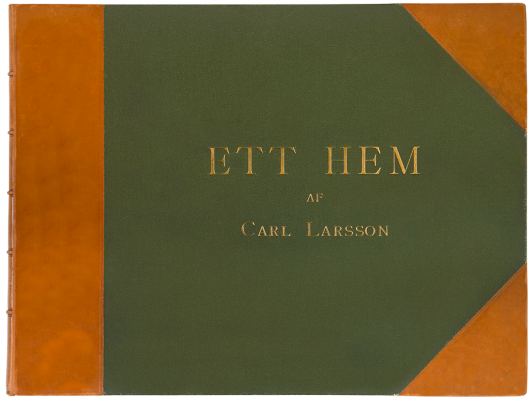
Carl-Larsson-Book-A-Home-1899
Carl-Larsson-Book-Spadarvet-1906
Carl-Larsson-Book_On-the-Sunny-Side-1910

Carl's books – a window into the artist's home

Carl's books – a window into the artist's home

Carl Larsson’s books provide a unique insight into his artistry, life, and visions. Through these works, we see how Carl Larsson and Lilla Hyttnäs have become a central part of Swedish cultural history and how they continue to inspire to this day.

Carl Larsson Garden Quote Studio Barden
My-Loved-Ones-Watercolor-Carl-Larsson-1893

MY LOVED ONES. Watercolor, Carl Larsson, 1893.

Carl depicts his family outside their home in Sundborn in 1893. Karin wears the red shawl with pompoms over her shoulders and stands surrounded by the children. The work marks the beginning of a significant stylistic transformation in Larsson’s painting. In the watercolor, he works with a decorative style using “⁠only contours and simple color planes.⁠” This approach characterizes his future production and depiction of the modern Swedish home.

My Loved Ones 1895

In the book “My Loved Ones,” Carl Larsson depicts his family and home at Lilla Hyttnäs, Sundborn. With humor, intimacy, and everyday moments, the book highlights what matters most to the artist—the family, my loved ones. Through personal and detailed illustrations, Carl Larsson invites the reader into the family’s daily life. The home takes center stage, and Karin is portrayed as both the heart of the family and Larsson’s artistic soulmate.

The book represents an important step in Carl Larsson’s artistic development. By drawing his family and the life unfolding in the home, he finds an expression that feels close and authentic. The book shows how he draws inspiration from the everyday and allows his love for the family to become a central part of his art.

The-Veranda-Watercolor-Carl-Larsson-1899

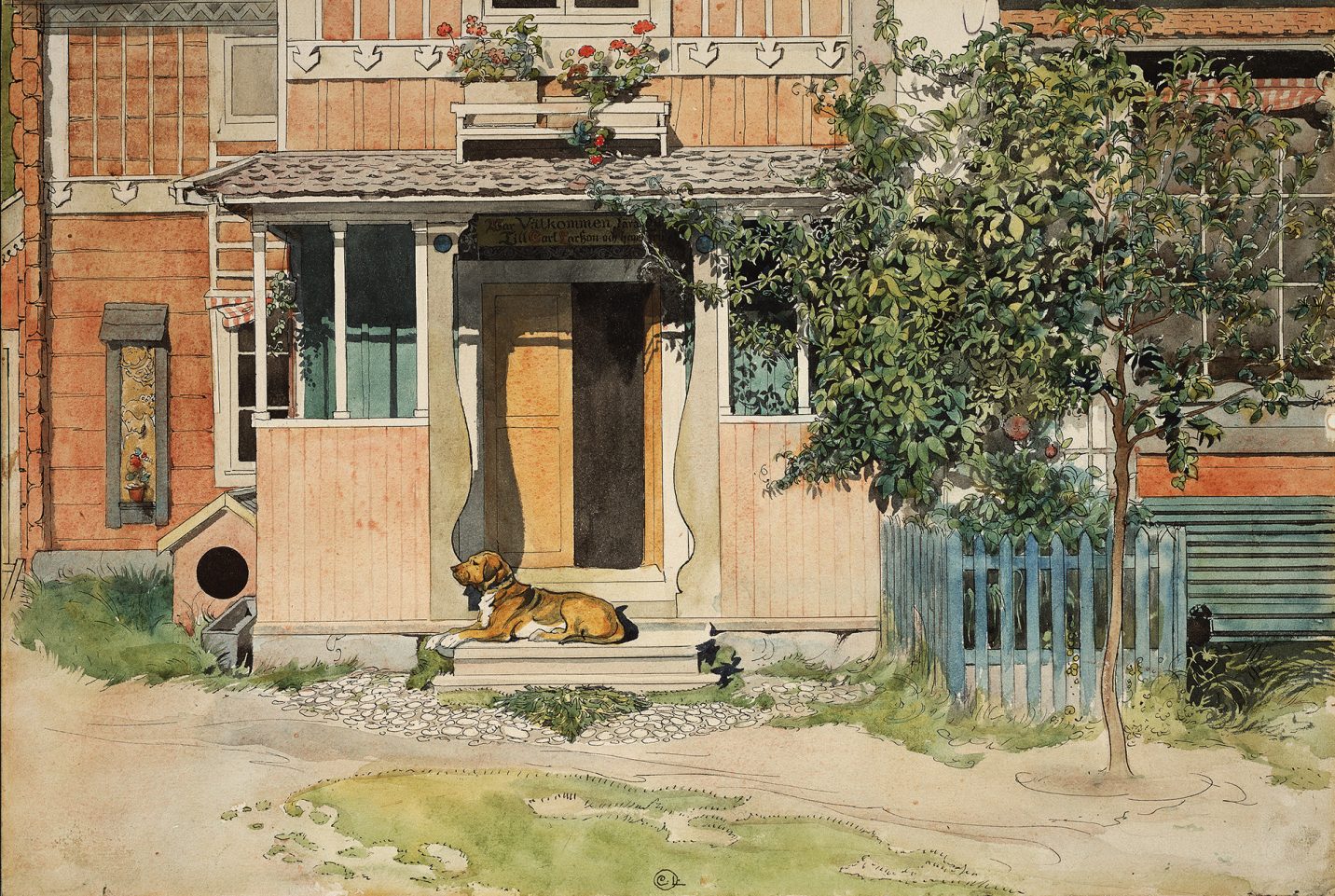
THE VERANDA. Watercolor, Carl Larsson, 1896.

The dog Capo lies in front of the veranda. Capo was the whole family’s favorite. The son Ulf writes in an essay, “⁠Of what breed he was, I cannot say, but he resembled the hound quite closely, though coarser and stronger than this.⁠” Above the door, the inscription reads “⁠Welcome, dear one, to Carl Larsson and his wife.⁠”

A Home 1899

In “A Home,” Carl Larsson opens the door to the family’s life at Lilla Hyttnäs. It becomes a turning point as he highlights the personal and genuine—something that differs from the ideals of the time.

The home is equally Karin Larsson’s creation. She designs the furniture, selects colors and textiles, and creates an environment characterized by simplicity and function. The book becomes a joint work of art where her sense of form and his brush meet. It is groundbreaking and inspires a new view of home decoration and family life.

It is through “A Home” that Carl Larsson becomes beloved throughout the world. During his lifetime, the images spread in Sweden and Germany, but when the copyright expires in 1969, the paintings are reproduced in mass editions—often with poor print quality and inadequate color reproduction. Despite this, Carl Larsson’s wish for art to be disseminated among the people is fulfilled.

Congratulations-Watercolor-Carl-Larsson-1906

CONGRATULATIONS. Watercolor, Carl Larsson, 1899.

The painting shows a celebration on Karin’s name day. The daughter Suzanne and some girls of the same age have dressed up as the Neck and his daughters. The family is very fond of festivities of this kind, and Carl Larsson describes in “A Home” how the celebration of all special days begins as early as five o’clock in the morning with salutes, singing, and music.

The Larssons 1902

The book “The Larssons” is published as a sequel to “A Home.” It contains 32 watercolors in which Carl Larsson continues to depict his home, his family, and everyday life in Sundborn. He deepens his tribute to simplicity, light, and family life as artistic motifs.

The book consolidates the turning point begun in earlier works. By documenting the home’s everyday moments—furniture, children, bright rooms, and family life—he shows that beauty exists in the everyday. He establishes an entirely new expression for Swedish art where the home becomes both life and art. With “The Larssons,” Carl Larsson makes the home and family the heart of his art—an ideal that inspires long after his time.

A-Fairy-Watercolor-Carl-Larsson-1899

A FAIRY. Watercolor, Carl Larsson, 1899.

In-the-Hawthorn-Hedge-Watercolor-Carl-Larsson-1897

IN THE HAWTHORN HEDGE. Watercolor, Carl Larsson, 1897.

Nap-in-the-Green-Watercolor-Carl-Larsson-1897

NAP IN THE GREEN. Watercolor, Carl Larsson, 1897.

Spadarvet-Watercolor-Carl-Larsson-1906

SPADARVET, MY LITTLE FARM. Watercolor, Carl Larsson, 1905.

SPADARVET, MY LITTLE FARM.
Watercolor, Carl Larsson, 1905.

The title page for the book “⁠Spadarvet – My Little Farm.⁠” Two children play with pine cones and Dala horses, and the Swedish flag waves gently in the center. Behind them, yellow lilies and ox-eye daisies grow against the green hedge. The composition frames the theme of the book, which depicts the year’s work on the farm Spadarvet.

Spadarvet 1906

“Spadarvet” is published as a picture book in which Carl Larsson depicts everyday life on the farm. Through motifs of work, animals, and nature, he expands his art from the home and family to also show life outdoors—in fields, in barns, and in gardens.

The book deepens his idea that art belongs in the everyday, both indoors and outdoors. It highlights rural life as a central part of the Swedish life ideal he portrays. At the same time, “Spadarvet” documents a countryside and a way of life that is about to change, giving the paintings a cultural-historical value beyond their artistic quality.

Carl Larsson purchases the farm Spadarvet adjacent to Lilla Hyttnäs in 1897.

Hide-and-Seek-Watercolor-Carl-Larsson-1908

HIDE AND SEEK. Watercolor, Carl Larsson, 1908.

The daughters Brita, Kersti, and Lisbeth search for their little brother Esbjörn. Karin has sewn the costumes for paintings with historical motifs that Carl Larsson has painted over the years. The composition of the painting is broken by the red crown imperial in the foreground, which contributes to the viewer feeling close and participating in the children’s play.

On the Sunny Side 1910

A book filled with bright and cheerful illustrations, in which Carl Larsson shows his artistic development and his love for life at Lilla Hyttnäs. 

“On the Sunny Side” is exactly what the title suggests—a tribute to light, joy, and the bright moments in family life. “On the Sunny Side” becomes a great success and participates in several important exhibitions in Europe and at the Panama-Pacific International Exposition in San Francisco in 1915, where Sweden’s art department receives very favorable reviews. Professor Eugen Neuhaus (Member of the International Jury of Awards in the Department of Fine Arts of the Exposition) writes in a mention of the exhibition: “⁠Of all the foreign nations represented, with the exception of Japan and China, none possesses so distinct a national character as the art of Sweden. I cannot refrain from expressing my personal conviction that it is the best national section in the entire exhibition.⁠”

Murre-Casimir-Laurin-Watercolor-Carl-Larsson-1900

MURRE CASIMIR LAURIN. Watercolor, Carl Larsson, 1900.

Carl portrays the three-year-old Casimir Laurin, son of the artist’s friends and patrons Carl G. and Gunilla Laurin, sitting on a rocking horse in 1900. The boy in a red outfit poses in an elegant room with decorated wooden panels. The watercolor has preserved its colors, especially red and green, in a remarkable way. The work is housed at the National Museum in Stockholm.

Nerium-Ingrid-W-Watercolor-Carl-Larsson-1912

NERIUM INGRID W. Watercolor, Carl Larsson, 1912.

Carl paints Ingrid Waldnér, niece of his son-in-law Petrus Ranström, who is married to Suzanne. In a fine summer dress and with a white bow in her hair, she stands outside the whitewashed studio wall in front of the oleander bush in the garden at Lilla Hyttnäs. The tree is in full bloom with its deep red clusters. Up on the balcony in the background stands twelve-year-old Esbjörn.

Other People's Children 1910

“⁠Other People’s Children⁠” consists of 32 watercolors in which Carl Larsson paints children from different environments and everyday situations. By depicting other children’s personalities and expressions, he shows that his interest in the human extends beyond his own family in Sundborn.


The book broadens his motifs while he maintains his warm and intimate view of everyday life. It strengthens the idea that childhood, play, and human closeness are universal themes that deserve to be highlighted in art. With “⁠Other People’s Children,⁠” Carl Larsson establishes the child’s world as a central artistic motif in its own right.

Self-Portrait-Oil-Carl-Larsson-1918

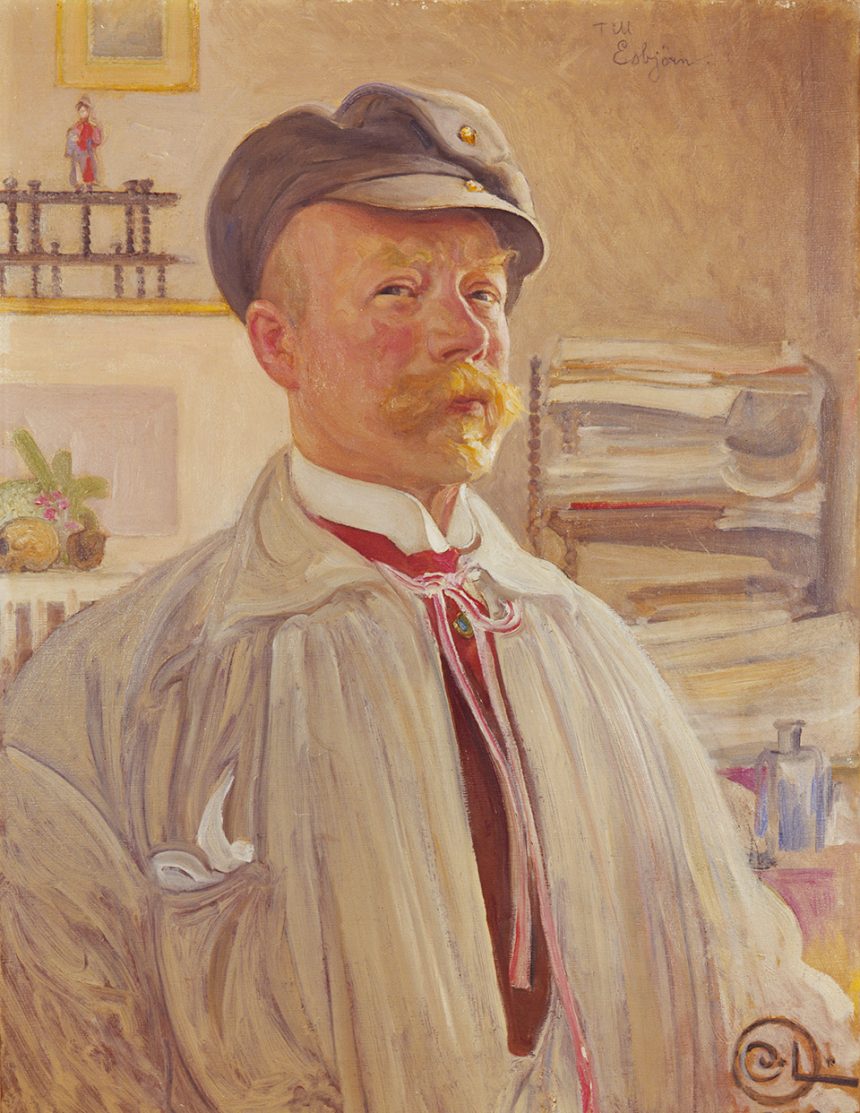
SELF-PORTRAIT. Oil, Carl Larsson, 1918.

Carl Larsson paints his self-portrait at 65 years of age, one year before he dies in 1919. He stands in his studio wearing a coat. In the background, books and paintings can be seen that testify to his artistic activity. The birthday is celebrated in Sundborn, and according to tradition, the celebration begins in the morning with a tribute in bed. At dinner in the evening, he honors Karin with a verse that ends: “⁠And thank you for your love! and thank you for your faith! And that I, ugly duckling, was allowed to build a nest with you.⁠”

I 1931, published posthumously

“I” is published as Carl Larsson’s autobiography, in which he tells his own story for the first time. He openly depicts his difficult childhood in Stockholm’s poor neighborhoods, the years in Paris, and meetings with artists such as Anders Zorn and Albert Engström. He tells of conflicts with August Strindberg and of his love for Karin and their life in Sundborn.

“I” becomes a key to understanding his art. Behind the idyllic home and family depictions is a person who has felt pain and longing, and who seeks security and community in art.