




MIDVINTERBLOT. Oil, Carl Larsson, 1914-1915.
Carl Larsson’s artistry possesses a unique ability to unite the personal with the national. His paintings reflect both his own life and Sweden’s cultural heritage. In his works, he transports us from family life in Sundborn to historical and artistic highlights in Swedish history. Experiencing Carl’s art in various museums and locations across the country provides a deeper understanding of his significance as one of Sweden’s most beloved artists. His work plays a central role in shaping the image of the Swedish home and Swedish identity.

PHOTO: Carl Larsson-gården.
Carl Larsson in his studio, wearing a white smock, in the process of painting the monumental ceiling mural “The Birth of Drama” for the Marble Foyer at the Royal Dramatic Theatre in Stockholm. The composition with nude figures symbolizes human passions and the course of life. In the background, Carl’s work “Gustav Vasa’s Entry into Stockholm” can be glimpsed.

MIDVINTERBLOT. Sketch, Carl Larsson, 1913.
Carl Larsson’s monumental mural “Midvinterblot” for the Nationalmuseum depicts a ritual sacrifice during midwinter in ancient Norse times. The motif is dramatic and symbolic rather than historically accurate. The composition sparked great controversy in 1911 and was rejected in 1916. The criticism deeply affected Carl. Since 1998, the work has hung in its intended place in the Nationalmuseum’s upper staircase hall.
Carl Larsson is one of Sweden’s foremost monumental painters. He debuted as early as 1880, before his artistic breakthrough, with a ceiling painting and wall panels in the Bolinderska Palace on Blasieholmen.
His art adorns many places: “Midvinterblot”, “Gustav Vasa’s Entry”, and the large frescoes in the Nationalmuseum’s staircase hall, the ceiling panel in the Royal Swedish Opera, “Ute blåser sommarvind” (Summer Wind Blows Outside) at Hvitfeldtska Gymnasium in Gothenburg.
The work is demanding. Each monumental painting involves extensive sketches and studies. When Carl painted the frescoes at the Nationalmuseum, he sometimes worked sixteen hours straight. The motifs were painted directly onto the wet plaster before it dried. He was assisted by the Italian stucco artist Antonio Bellio, the young painter Gustaf Fjaestad, and several Italian craftsmen.
Dalarnas Museum in central Falun is the county’s cultural history museum, reflecting the region’s rich heritage. Here you can see Dala horses, traditional folk costumes, Dalecarlian painting, Hagström electric guitars, and Selma Lagerlöf’s study.
Among the collections is also a part of Carl Larsson’s preliminary study for “Gustav Vasa’s Entry into Stockholm” as well as several paintings by Karin Bergöö Larsson.


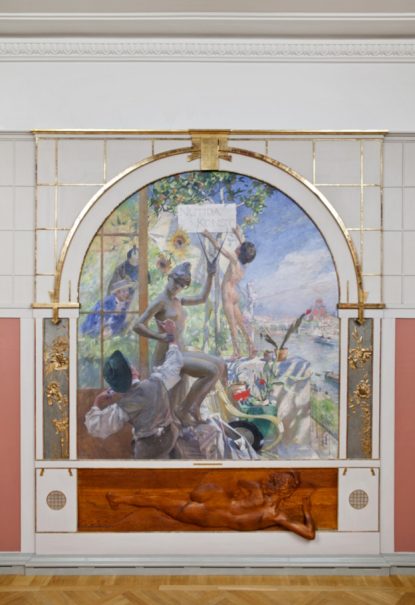
ROCOCO – RENAISSANCE – CONTEMPORARY ART. Oil, Carl Larsson, 1888-1889.
ROCOCO – RENAISSANCE – CONTEMPORARY ART.
Oil, Carl Larsson, 1888-1889.
Here, Carl’s triptych is displayed, celebrating three eras in art history: “Rococo – Renaissance – Contemporary Art”. In the central panel, art is resurrected and celebrated by the powers of the time. The Rococo panel shows a playful, pastoral scene. In the third painting, the viewer encounters modern art – with a Japanese artist, the Eiffel Tower under construction, and Carl himself depicted.
In 1889, Carl Larsson was awarded a First Class Medal for his triptych. The same year, he and Karin moved to Lilla Hyttnäs in Sundborn, which they had acquired the year before; it was not until 1901 that the home became the family’s permanent residence. In 1891, he also won first prize in the competition for the Nationalmuseum’s murals.
The Gothenburg Museum of Art houses one of Sweden’s foremost collections of Nordic art from the late 19th century. In the Fürstenberg Gallery, named after the patrons Pontus and Göthilda Fürstenberg, several of Carl Larsson’s most significant works are displayed. Among these is the triptych “Rococo – Renaissance – Contemporary Art” (1888–1889). In it, Carl Larsson celebrates three eras in art history. The central panel, Renaissance, shows an artist bringing the ideals of antiquity to life. He is surrounded by symbols of the church, principality, and bourgeoisie.
Another important work is the watercolor “Interior from the Fürstenberg Gallery” (1885). In it, Carl Larsson depicts the Fürstenberg couple in their art collection. Pontus studies a work of art while Göthilda is portrayed by the artist Ernst Josephson.
Carl Larsson also painted the watercolors “November” and “October” for the Fürstenberg Gallery. “November” was originally called “Rimfrost” (Hoarfrost) and “October” is also known as “Pumporna” (The Pumpkins) and “Mère Morot”. Both works were exhibited at the Paris Salon and are considered some of Carl Larsson’s most important paintings from this period.
> Carl and Karin’s watercolors of Mère Morot
Commissioned by Pontus Fürstenberg, Carl painted watercolors of his own children. All watercolors are available for viewing at the museum.

FÜRSTENBERG GALLERY. Watercolor, Carl Larsson, 1885.
Carl’s watercolor featuring Ernst Josephson portraying Göthilda Fürstenberg, dressed in black and seated by the left wall – a portrait that was never completed. In the foreground, Pontus Fürstenberg is seen engrossed in a work on paper.
The Nationalmuseum in Stockholm houses several of Carl Larsson’s most significant works. In the museum’s upper staircase hall hang two monumental paintings: “Gustav Vasa’s Entry into Stockholm 1523” (1908) and “Midvinterblot” (1915). The former depicts Gustav Vasa’s triumphant entry into the capital, while “Midvinterblot” portrays King Domalde’s sacrifice to appease the gods. The work long sparked debate but is today considered one of Larsson’s masterpieces.
In the lower staircase hall, the walls are adorned with six frescoes. Carl painted them between 1896 and 1903. The frescoes feature motifs from Swedish art history, with figures such as David Klöcker Ehrenstrahl, Carl Gustaf Tessin, and Johan Tobias Sergel. Together, they constitute an artistic journey through Sweden’s cultural heritage.
The museum also displays watercolors from the series “A Home”, where Larsson depicts family life in Sundborn. These works shape the image of the Swedish home and the ideals surrounding art, everyday life, and aesthetics in turn-of-the-century Sweden.

GUSTAV VASA’S ENTRY INTO STOCKHOLM. Oil, Carl Larsson, 1891-1908.
GUSTAV VASA’S ENTRY INTO STOCKHOLM.
Oil, Carl Larsson, 1891-1908.
Carl Larsson’s monumental painting “Gustav Vasa’s Entry into Stockholm 1523” depicts the king’s solemn arrival in the capital after his victory in the war of liberation. This event laid the foundation for the modern Swedish state. Gustav Vasa rides a white horse over a flower-adorned drawbridge, received by the city’s burghers who hand over the keys to Stockholm. The scene captures both the gravity of history and the joy of the people.

AROUND THE EVENING LAMP. Watercolor, Carl Larsson, 1900.
The watercolor “Around the Evening Lamp” shows the family’s evening meal in the dining room at Lilla Hyttnäs. The children gather around the table. In the background stands mother Karin with their youngest son Esbjörn in her arms. In the foreground, Carl’s napkin is visible – tied in a knot, just as he usually does.
Thielska Galleriet on Djurgården in Stockholm houses one of Sweden’s foremost collections of Nordic turn-of-the-century art. Several works by Carl Larsson are found here. They were acquired by the banker and art collector Ernest Thiel, who was also a friend of the artist. A total of twenty-five artworks by Larsson were acquired for the Thielska collection – oil paintings, watercolors, charcoal drawings, and graphic prints.
Among the works is “Good Night” (1894), an atmospheric charcoal drawing. Also present are the vibrant watercolors “Around the Evening Lamp” (1900) and “Mother and Daughter” (1903). The paintings depict everyday scenes from family life in Sundborn. They capture tender moments where home, light, and intimacy are central.
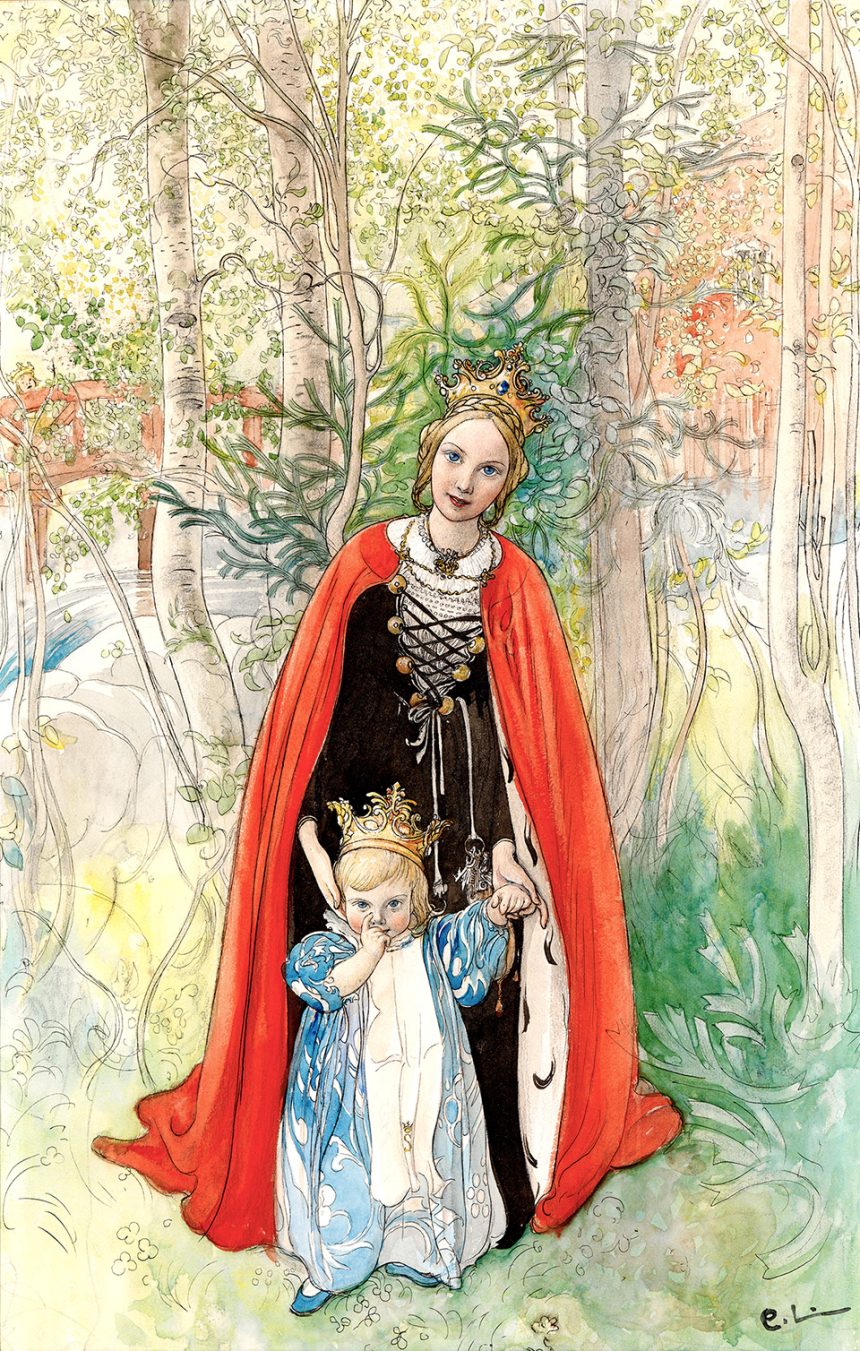
OUR PRINCESS. Watercolor, Carl Larsson, 1898.
Carl Larsson painted “Our Princess” as a tribute to spring. The painting shows Karin and their daughter Kersti in a flourishing garden. The work was created for the children’s magazine Jultomten and quickly became popular. It was sold and printed long after its time.
Prince Eugen’s Waldemarsudde, located on Djurgården in Stockholm, was home to Prince Eugen. Prince Eugen was an artist, collector, and a central figure in Swedish art life around the turn of the 20th century. He was also a close friend of Carl Larsson, and Carl’s works are exhibited at the museum.
Among Larsson’s works displayed at Waldemarsudde is “Our Princess” (1898), a vibrant watercolor depicting Karin and their daughter Kersti in a blooming garden. Also featured is Self-Portrait (1895), where the artist portrays himself in his characteristic style.
“With my works, I want to do something good and joyful for the Swedish people – something that can uplift their everyday lives.”
Carl Larsson
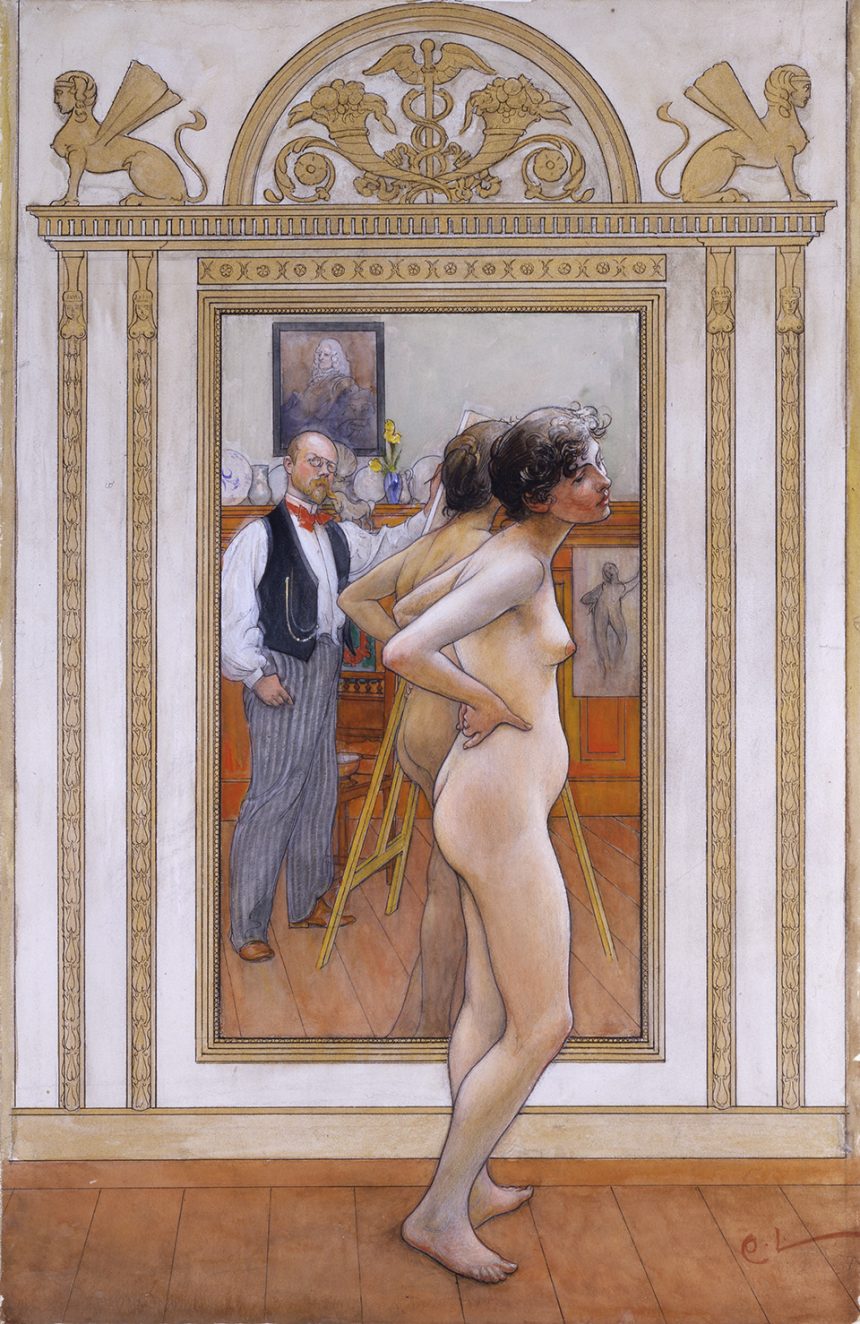
IN FRONT OF THE MIRROR. Watercolor, Carl Larsson, 1898.
The watercolor was commissioned by Anders Zorn and shows the model Louise in front of an Empire mirror that once belonged to the actress Emilie Högqvist. The mirror is still preserved in a washroom at Carl Larsson-gården. Louise later became an actress herself, which adds an extra dimension of theatrical presence to the motif.
The Zorn Museum in Mora was home to the artist Anders Zorn and his wife Emma. The lavish house from 1910 combines Swedish tradition with international influences. The Zorn couple traveled extensively. However, they had strong roots in Dalarna and were engaged in cultural and social issues.
The relationship with Carl and Karin Larsson was both friendly and complex. The couples shared an interest in Swedish culture, although their expressions differed. A mutual respect and a desire to leave a mark united them.