


DIED: January 22, 1919, in Falun.


SELF-PORTRAIT. Watercolour, Carl Larsson, 1912.
Carl sits in the studio at Lilla Hyttnäs painting his self-portrait in 1912. It has been a long road to get here. He was born in the Old Town of Stockholm in May 1853. The family was very poor, and Carl grew up under difficult circumstances. He moved forward in life with the joy of creation as his driving force, and after the Royal Academy of Fine Arts, he headed to Paris and France. After facing setbacks in Paris, he made his way to the Scandinavian artists’ colony in Grez-sur-Loing. It was there he met Karin. He abandoned pretentious oil paintings and transitioned to painting watercolors. Together with Karin, he later created one of the world’s most famous artist homes – a home that continues to influence and inspire.
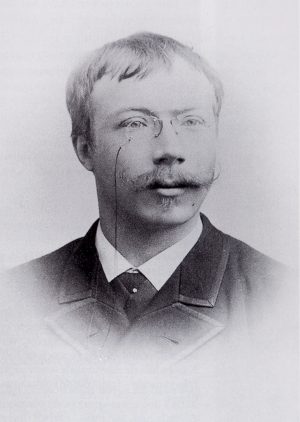

BORN: May 28, 1853, in Stockholm.
EDUCATION: The Primary School and the Royal Academy of Fine Arts.
FAMILY: Parents: Olof and Johanna Larsson. Married Karin in 1883.
CHILDREN: Suzanne 1884–1958, Ulf 1887–1905, Pontus 1888–1984, Lisbeth 1891–1979, Brita 1893–1982, Mats 1894–1895 (died at two months old), Kersti 1896–1975, and Esbjörn 1900–1937.
IMPORTANT YEARS: In 1877, Carl went to Paris for the first time, and in 1881, he arrived at the Scandinavian artists’ colony in Grèz-sur-Loing, where he began watercolor painting and met Karin. In 1888, Carl and Karin received Lilla Hyttnäs from Karin’s father, and in 1891, they moved there. The paintings from the home quickly became popular and widely distributed. In 1896, Carl decorated the Nationalmuseum with large murals, but in 1911, his sketches for Midvinterblot were rejected. Over 80 years later, in 1992, Midvinterblot was finally installed.
DIED: January 22, 1919, in Falun.


PHOTO: The Carl Larsson Family Estate.


PHOTO: The Carl Larsson Family Estate
Carl Larsson – from the alleys of Stockholm to Sundborn. As a young art student, Carl Larsson dreams of a future as an artist. In his mature years, the dream has become reality – he is now one of Sweden’s most appreciated artists, living in Sundborn with Karin and the children.
Even as a young boy, Carl is creative, and with a large pair of scissors, he cuts out figures from his father’s laboriously gathered book collection. As soon as he gets hold of a piece of paper and a pencil stub, he sits down to draw. At the age of thirteen, his teacher, Master Vilhelm August Jakobsson at the Ladugårdslandet free school for the poor, encourages him to apply to the preparatory department of the Royal Academy of Fine Arts, the so-called Primary School.
The first years at the Primary School are tough. Carl finds it difficult to settle in. He feels socially inferior and excluded. But that changes when, at sixteen years old, he is promoted to the Antique School, the lowest department of the Royal Academy of Fine Arts. There, he feels more confident and becomes one of the central figures in student life.

STEN STURE THE ELDER DELIVERING QUEEN CHRISTINA OF DENMARK FROM VADSTENA ABBEY. Oil, Carl Larsson, 1876.
Carl Larsson distinguishes himself even as a student and is repeatedly rewarded during his education at the Primary School and the Royal Academy of Fine Arts – with medals, cash prizes, and commendations for his painting. In 1876, he receives the Royal Medal for “Sten Sture the Elder Delivering Queen Christina of Denmark from Vadstena Abbey”.

IN THE BUDDING SPRING. Oil, Carl Larsson, 1881.
In the painting “In the Budding Spring”, the motif is taken from the artist’s garden in Montmartre, Paris. Carl lives here and struggles to break through as an artist during the early 1880s. In a letter to August Strindberg, Carl describes his home as simple but idyllic, with apricot trees, grapevines, and lilac bushes. Here he has a small patio with a view of the city – a sanctuary for Scandinavian artists. Despite diligent work and an inspiring environment, major recognition only comes at the World’s Fair in Paris in 1889.
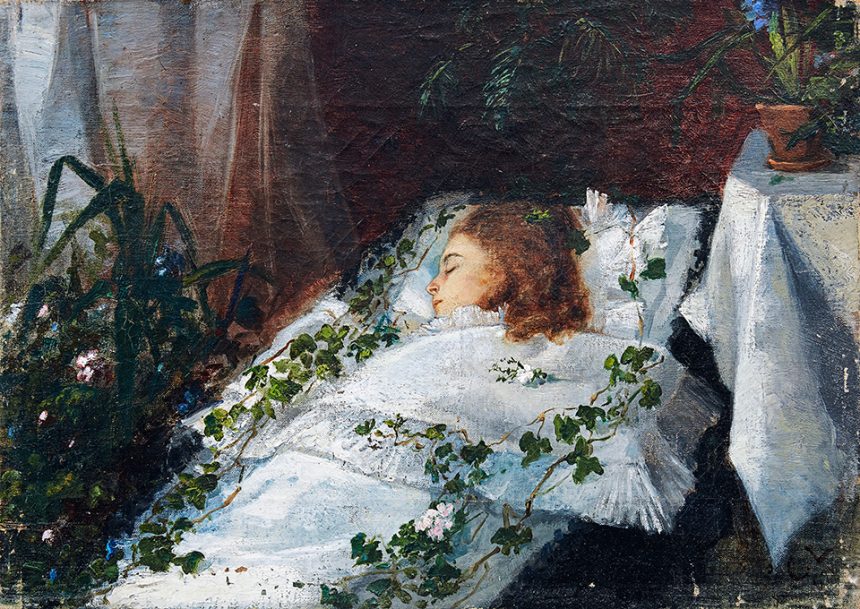
IN ETERNAL REST. Oil, Carl Larsson, 1878.
“In Eternal Rest” – A sensitive oil painting that immortalizes Carl Larsson’s love and friend, Wilhelmina Holmgren, who tragically passed away in 1877. Wilhelmina, herself an artist and student at the Royal Academy of Fine Arts, was a crucial pillar of support during Carl’s early artistic career. After her passing, Carl travels to Paris to try to establish himself as an artist – a period marked by both creative endeavor and personal grief.
After the Royal Academy of Fine Arts, Carl works illustrating books, magazines, and newspapers. He has a relationship with Wilhelmina Holmgren, and they have two children. But tragedies follow – within the span of two years, both children die of illness, and Wilhelmina passes away in childbirth in 1877. Carl carries a deep sorrow when he heads to Paris, where he spends several years trying to establish himself as an artist. Despite hard work, success remains elusive.
The turning point comes when he heads to the Scandinavian artists’ colony of Grez-sur-Loing outside Paris in 1882. There he meets his Karin Bergöö, and a deep love arises. They marry in 1883. Their relationship is not just a romantic love story but also an artistic collaboration.
The Nordic light and French rural life inspire him to experiment with Impressionist techniques. Together they create a home where art and life merge, and where he finds the balance between tradition and innovation that will characterize his mature works.
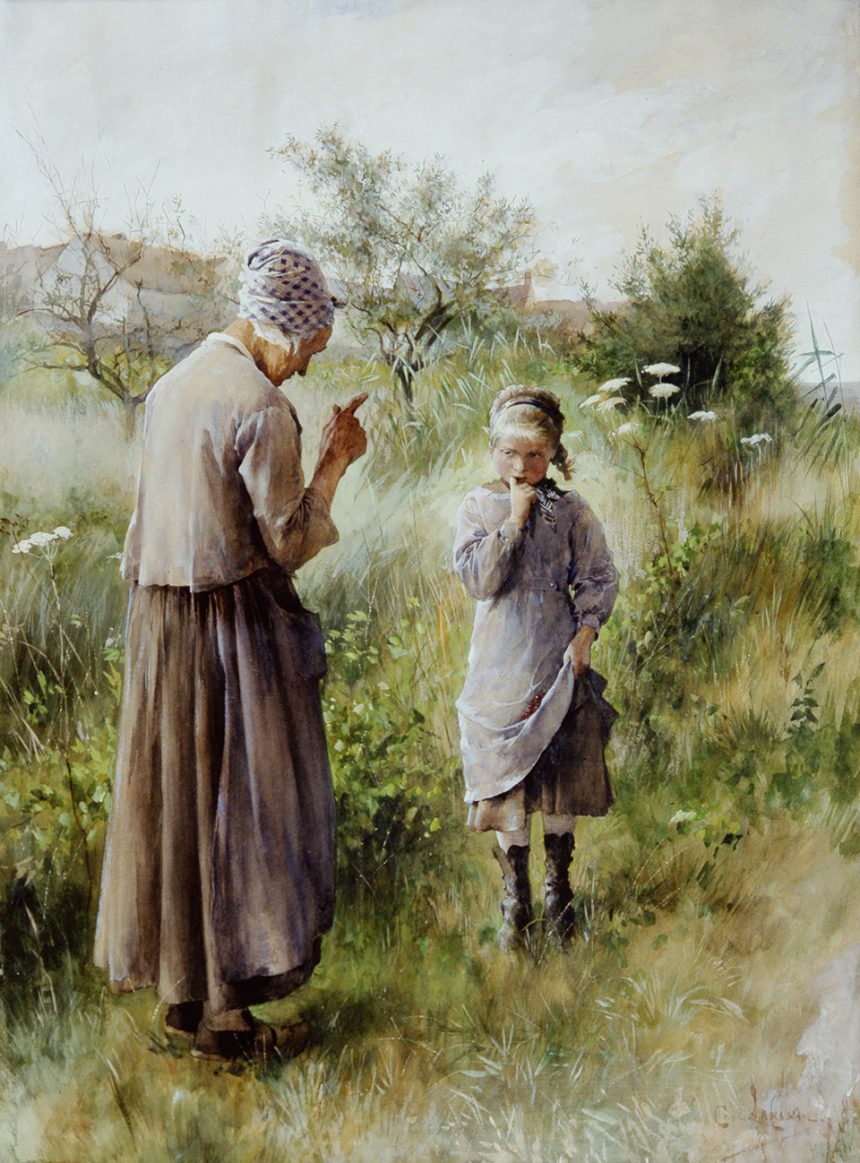
FORBIDDEN FRUIT. Watercolor, Carl Larsson, 1882.
“Forbidden Fruit” is Carl’s first watercolor. It was created in the artists’ colony of Grez-sur-Loing in the summer of 1882. The painting marks the start of a new phase in his artistic development with a realistic plein-air style that lays the foundation for future experiments with light and color. Grez also becomes a turning point in his personal life. It is here he meets Karin, and in 1883 they marry, a relationship that becomes both romantic and artistic.

PHOTO: The Carl Larsson Family Estate.
In 1888, the Larsson family travels to Paris, where Carl begins the “Fürstenberg Triptych” – with the motifs Renaissance, Rococo, and Modern Art. The following year, the work is awarded a first-class medal at the World’s Fair in Paris in 1889. This becomes Carl’s breakthrough. With success behind him, the family returns to Sweden and to their new home, Lilla Hyttnäs in Sundborn.
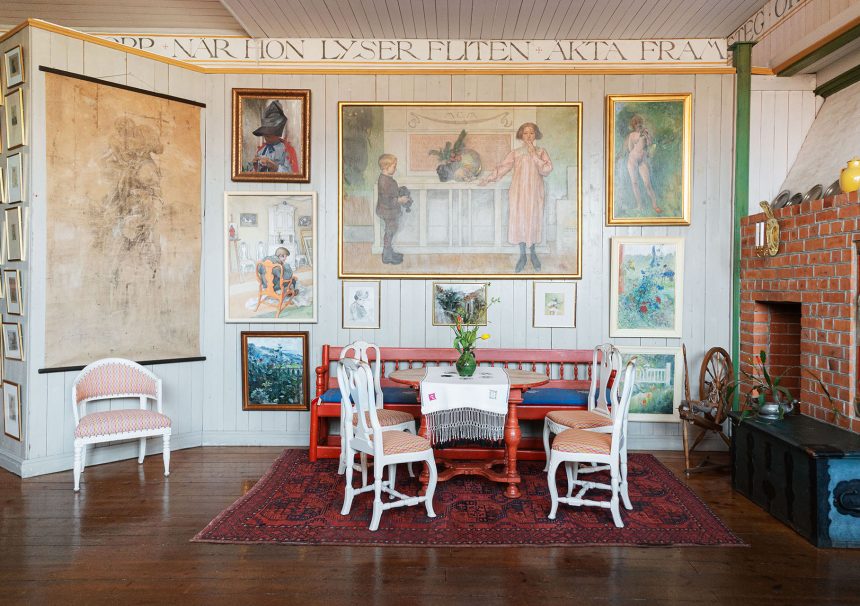
Adolf Bergöö, Karin’s father, gifts a small house – Lilla Hyttnäs in Sundborn, Dalarna – to the Larsson family in 1888. It becomes Carl and Karin’s joint art project. Their artistic talents find an outlet in a very modern and personal architecture, color scheme, and interior design. Here they create together the home that will become an icon of Swedish interior design.
Carl draws his greatest inspiration from his family – the eight children and Karin – who are all frequently depicted in his paintings. The home they create together, where Karin’s creativity shines brightly, is the heart of the works and conveys the famous feeling of coziness, community, and harmony. Without Karin’s artistic contribution – her textiles, color choices, and interior design – Carl’s work would never have gained the same life and depth.
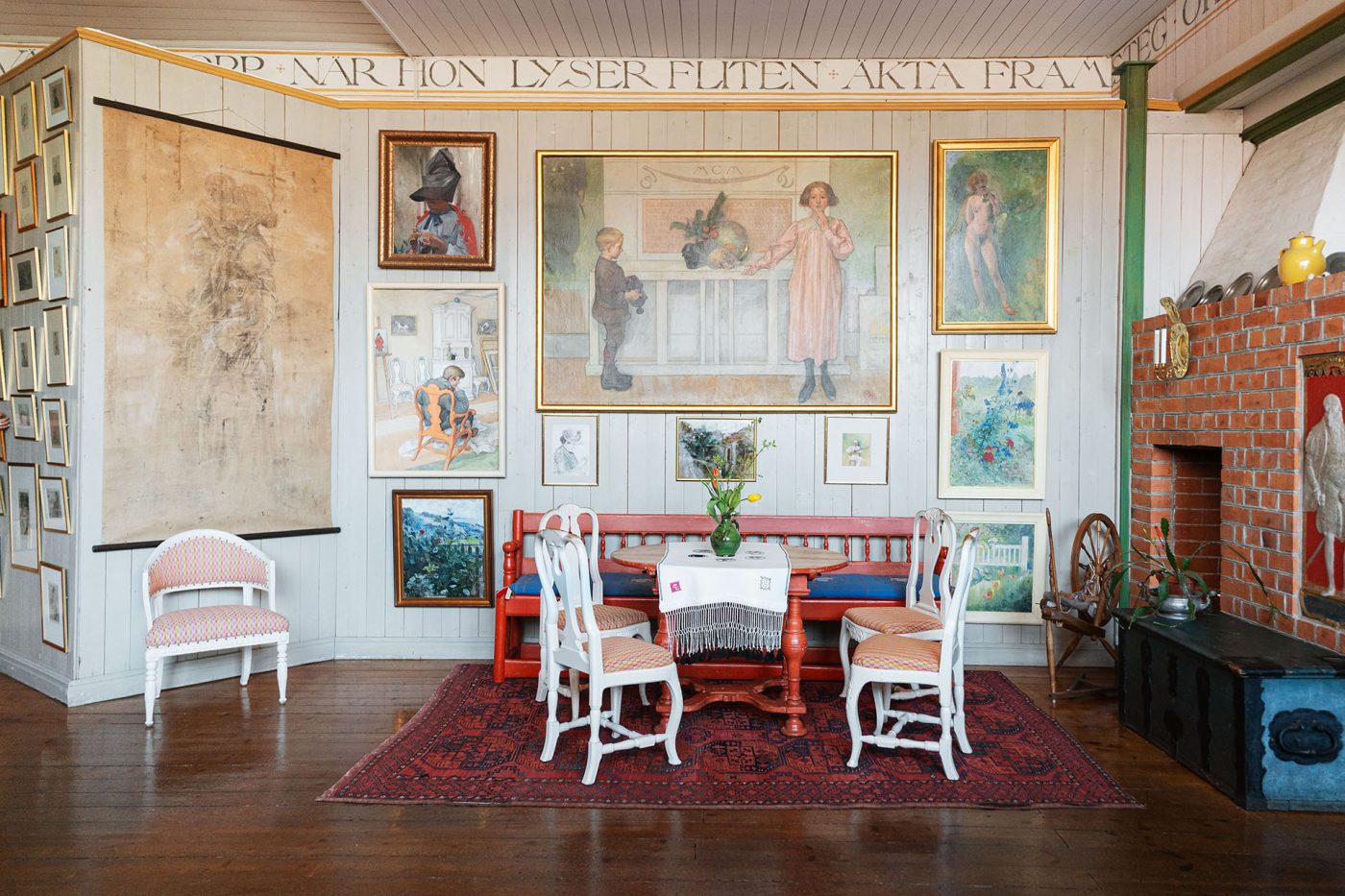
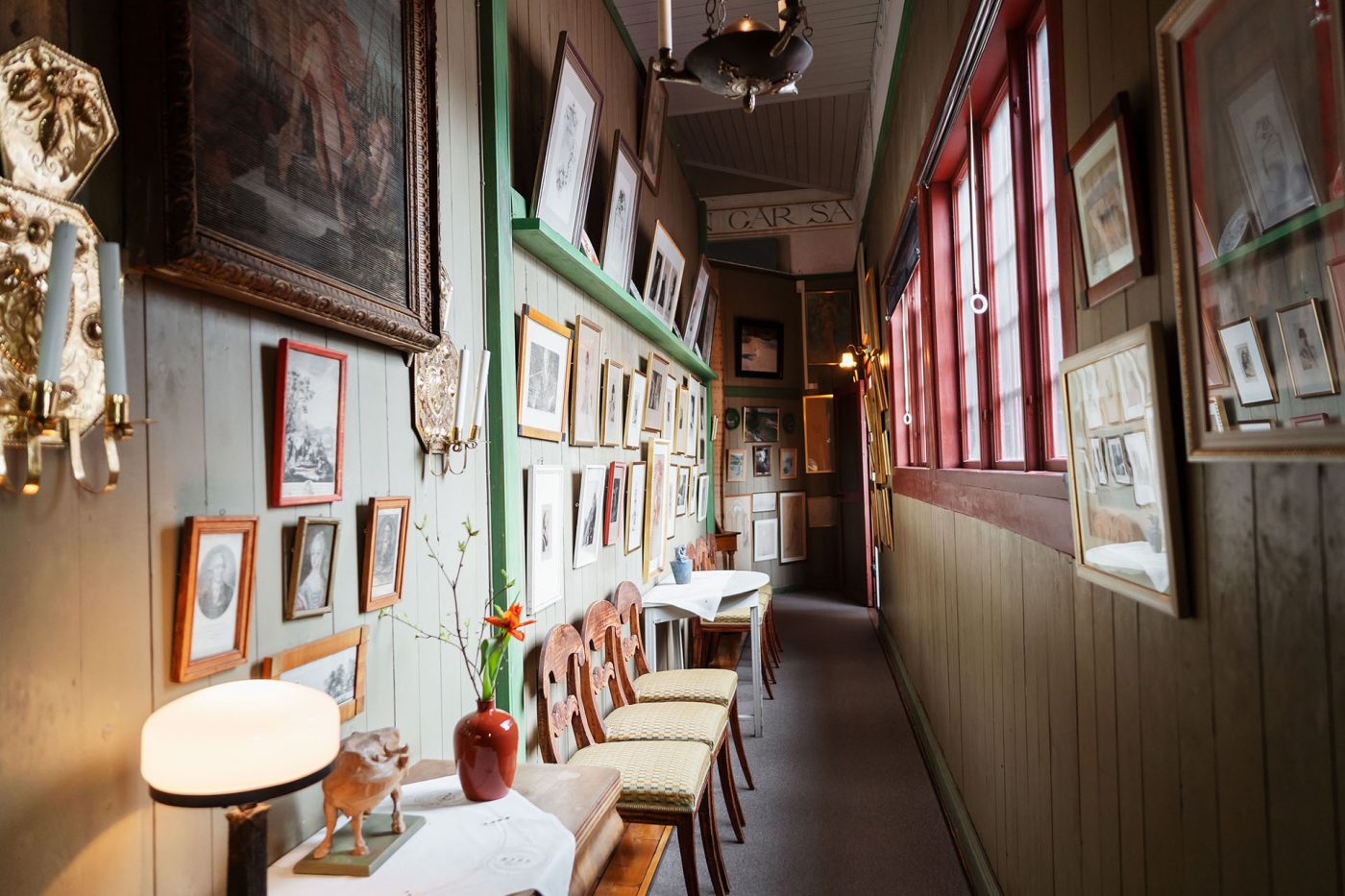
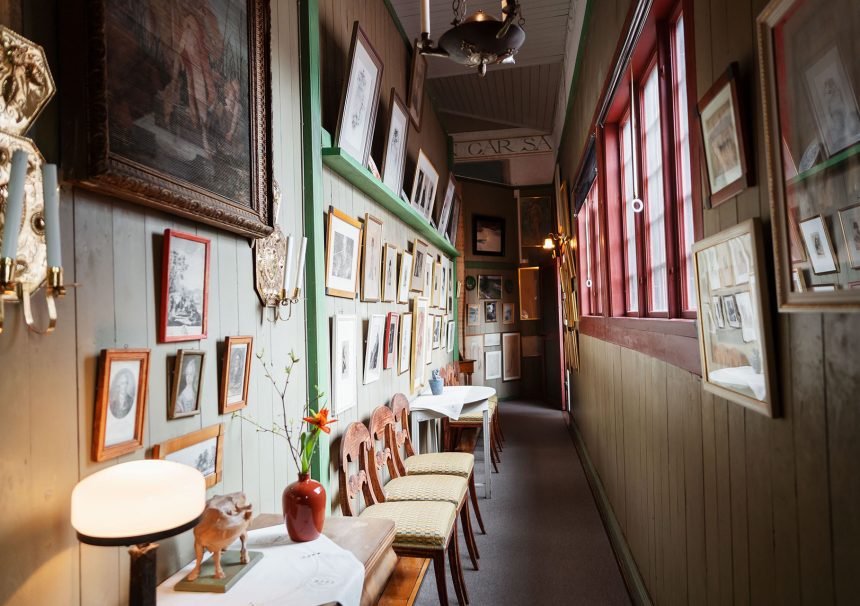
The house still looks as it did in Carl and Karin’s time, and those who visit Lilla Hyttnäs today can almost hear the wild laughter of children and smell the scent of paint.

PHOTO: The Carl Larsson Family Estate.
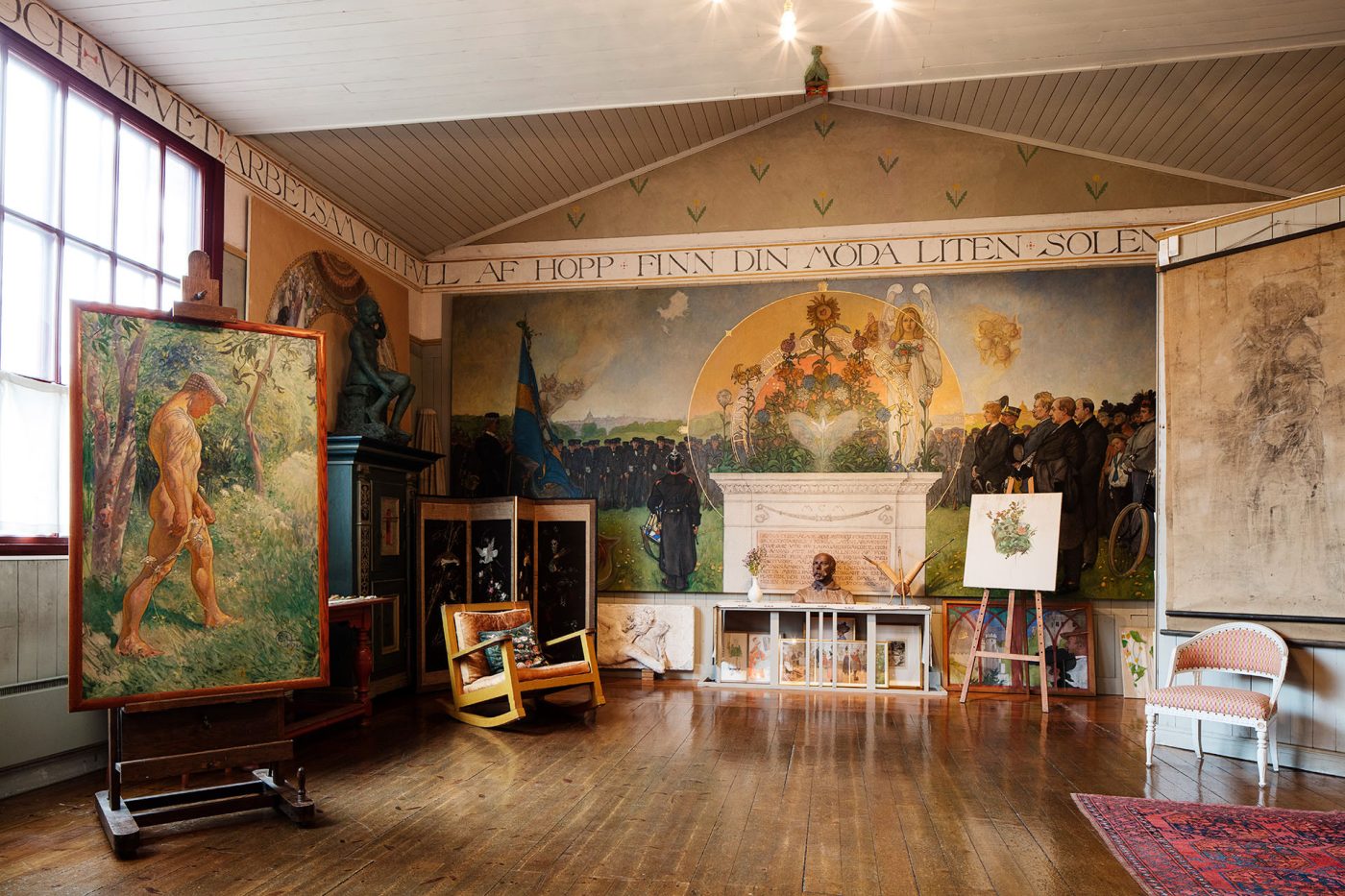
The walls are covered with paintings in various stages; easels and frames fill the room in the studio where Carl Larsson creates many of his works. It is a room where art and everyday life flow together. Behind Carl Larsson, the portrait of carpenter Hans Arnbom is visible, a painting that is part of the portrait collection in Sundborn.

PHOTO: The Carl Larsson Family Estate.
Carl Larsson at work at Lilla Hyttnäs. Dressed in his white painting suit, he captures the house’s characteristic facade and the surrounding garden. Karin sits on the veranda embroidering, and one of the children sits on the bench. Perhaps it is her he is painting?
Carl Larsson’s early artistic career is marked by hard work and the quest to find his own style. He begins working early as a book illustrator and portrait painter, but it is his watercolors of the Swedish home and family life that truly make him famous. Carl also works for a time as a teaching artist and instructor at the Royal Academy of Fine Arts and later at the Valand School of Fine Arts in Gothenburg.
During his life, Carl becomes one of Sweden’s most prominent artists. His work includes not only watercolors but also larger monumental works such as the frescoes in the Nationalmuseum in Stockholm. His style is unique, combining realism with decorative art, making him a central figure in the Swedish Arts and Crafts movement. His art and ideas influence artistic life throughout Sweden.
Despite artistic success, Carl Larsson also faces challenges, both financial and personal. He sometimes struggles to obtain enough commissions to support his large family. Carl’s greatest support is Karin, who is not only his life partner but also an artist and designer. Her contribution is crucial to the artistic whole they create together.
Carl remains a committed and active artist throughout his life and continues to create even during his final years. His work has a lasting impact on Swedish art and culture and is still loved and admired worldwide today.

PHOTO: The Carl Larsson Family Estate.
Karin was not just a support – she was a co-creator of what is today perceived as Carl Larsson’s artistic universe, a constantly present advisor and source of inspiration who contributed to the entirety of his work. Here they are seen in conversation in the studio. Martina Eriksson of the Larsson household recounts: “When the artist was to sign a painting, he never did so except in the mornings. If the mistress was not at hand, I had to run for her. They stood for a long time before the painting with their arms around each other and had a conversation about lines and colors. Finally, the mistress said: ‘Don’t touch it anymore, Carl – it is good.’“

SCANDINAVIAN ARTISTS’ LUNCHEON AT CAFÉ LEDOYEN. OIL, HUGO BIRGER, 1886.
Carl Larsson is seen in the center of the image, toasting at the table during a luncheon at Café Ledoyen in Paris in 1886, depicted in Hugo Birger’s painting “Scandinavian Artists’ Luncheon”. Together with artists such as Ernst Josephson, Georg Pauli, and Gerda Hagborg, Larsson experiences a time filled with community and creative joy. It is a clear contrast to the lonely years in the early 1880s when he struggled to break through as an artist.
In addition to income from art and books, Carl Larsson receives support from Pontus Fürstenberg, a Swedish art collector, patron, and art dealer from Gothenburg. Fürstenberg is one of Carl’s greatest admirers and buys several of his works. This provides Carl with financial security and greater international visibility. Carl also gains attention in Swedish and international artistic circles, where his artistic talent is recognized and appreciated.

PHOTO: Nationalmuseum.
Carl Larsson working on the frescoes for the Nationalmuseum’s grand staircase. The high scaffolding and the monumental format show the scale of the project. The frescoes, depicting motifs from Swedish history and culture, become one of Larsson’s most significant public commissions and solidify his position as one of Sweden’s foremost artists.
One’s own image of oneself as an artist and that of the outside world do not always coincide. Despite great success with his beloved watercolors, Carl considers his monumental works to be the most significant. It is the frescoes in schools, museums, and other public buildings that he himself values most highly.
The disappointment is therefore great when his final monumental work, “Midvinterblot”, intended to adorn the grand staircase in the Nationalmuseum in Stockholm, is rejected by the board. In his memoir “Jag” (I) from 1931, he expresses his bitterness. He himself considers “Midvinterblot” to be his artistic pinnacle.
“The fate of Midvinterblot broke me! With dull anger, I admit this. And yet it was probably for the best, for now my intuition tells me – again! That this painting, with all its weaknesses, shall one day, after I am gone, be honored with a far better place.”
From Carl Larsson’s memoirs “Jag”, published 12 years after his death, in 1931.
Time finally proves him right. After “Midvinterblot” was sold to Japan, the painting was returned to the Nationalmuseum for the Carl Larsson exhibition in 1992. With the help of generous private donors, the museum purchased the work from the Japanese owner in 1997. Now the painting finally hangs in the place where it was intended to be. Carl can enjoy the fact that “Midvinterblot” is home.
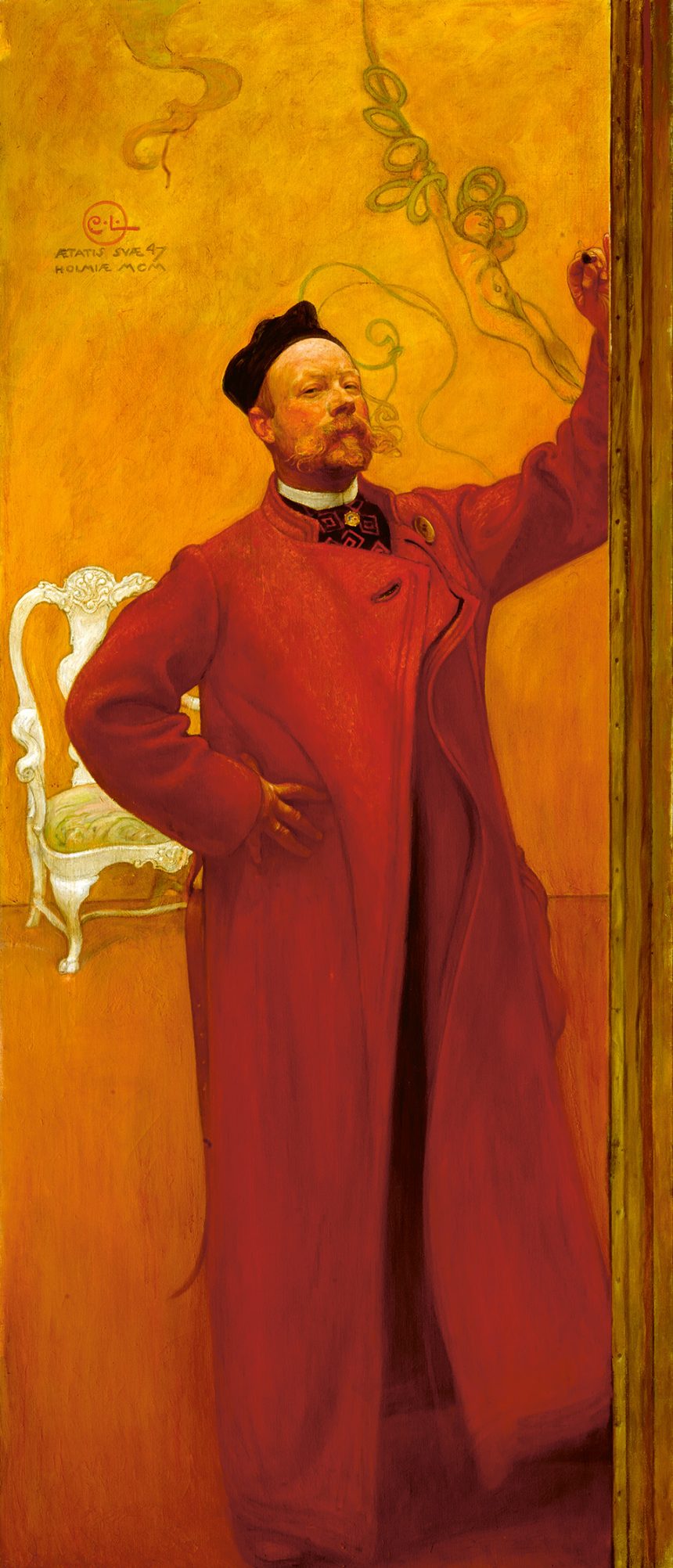
BEFORE THE MIRROR. Oil, Carl Larsson, 1900.
Carl Larsson exudes self-assured strength, his gaze fixed on the viewer, the charcoal resting in his hand while the canvas stands taut beside him. The warm yellow background bears decorative swirls, rings, and a floating female figure – elements that show his artistic sense for ornamentation. The poor boy from the past has now become an influential artist: well-recognized, loved as a watercolorist, and a prominent voice within the Scandinavian art world.